
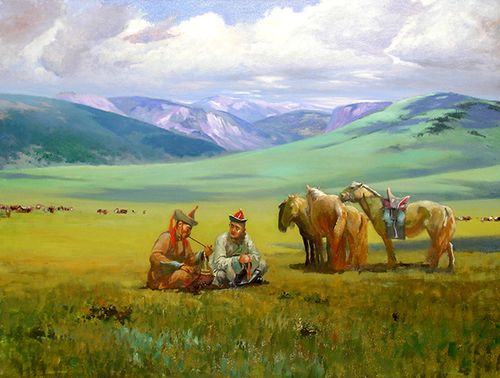
Visual Analysis In Interview, Batjargal Tseintsogzol demonstrates the mastery of Photorealism that defined his career. The painting captures a quiet, intimate moment that bridges the gap between traditional Mongolian life and a modern, observant eye.
The Subject: The composition likely focuses on a human interaction—possibly between an elder and a younger figure, or a visitor and a local—rendered with such precision that every wrinkle, textile texture, and play of light feels tactile.
Lighting and Texture: True to the Realism style, Tseintsogzol uses a sophisticated palette to mimic the natural lighting of the Mongolian steppe or a modest interior. His ability to render the specific sheen of silk del (traditional clothing) or the weathered skin of his subjects provides a documentary-like quality to the work.
Atmosphere: Despite the title suggesting a formal exchange, the 65 x 85 cm canvas creates a sense of stillness. There is an emotional weight to the “interview,” suggesting that what is being shared is not just words, but heritage and personal history.
Context and Style Born in Ulaanbaatar, Tseintsogzol was a pivotal figure in contemporary Mongolian art. Interview is a prime example of his dedication to Nature and the human condition. By applying the meticulous techniques of Western Photorealism to Mongolian subjects, he elevated the “everyday” to something cinematic and profound.
His work often explores the tension between Mongolia’s nomadic roots and its urban evolution. In this piece, the 2007 timeframe marks a period where Mongolia was rapidly changing, making this “interview” feel like a vital recording of a moment in time.
Note: Tseintsogzol’s legacy is defined by this “quiet realism”—a refusal to romanticize his subjects, choosing instead to find the extraordinary in their authentic, unvarnished presence.