
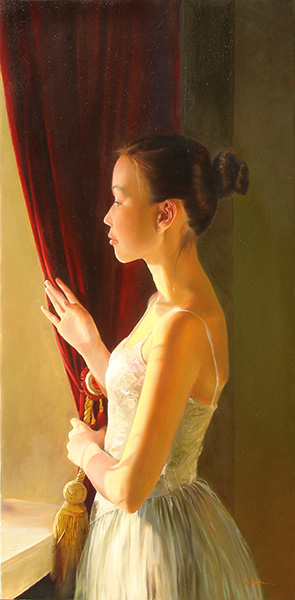
Ballerina

Batjargal Tseintsogzol , 2006 , Oil On Canvas

Batjargal Tseintsogzol’s Ballerina (2006) is a captivating study of poise, discipline, and the quiet intensity of the performing arts. Painted in oil on a horizontal 45 x 90 cm canvas, the work exemplifies Tseintsogzol’s mastery of Photorealism and his ability to find profound stillness within a subject defined by movement.

Composition and Form

The painting’s panoramic dimensions emphasize the elongated, elegant lines of the dancer. Rather than capturing a grand leap or a climactic stage moment, Tseintsogzol focuses on a moment of preparation or rest. The ballerina is rendered with meticulous anatomical precision, highlighting the physical strength required for her craft—from the tension in her arched back to the delicate placement of her hands.

Light and Texture

True to the Realism style, the artist utilizes light to create a three-dimensional depth that feels almost tangible.

  • The Tutu: The layers of tulle are handled with extraordinary detail, capturing the translucent quality of the fabric and the way it catches the light.

  • The Skin: Tseintsogzol applies thin glazes of oil to mimic the soft glow of skin against the harsher, matte textures of the background.

  • The Palette: The color scheme is typically muted, favoring earthy tones or soft pastels that prevent the technical virtuosity from overshadowing the emotional weight of the piece.

About the Artist: Batjargal Tseintsogzol (1966–2020)

Born in Ulaanbaatar, Mongolia, Tseintsogzol was a leading figure in contemporary Mongolian realism. His work often bridged the gap between traditional Mongolian sensibilities and Western academic techniques.

  • Style: While he was deeply influenced by Nature, his figurative works like Ballerina showcase his ability to treat the human form with the same reverence he held for the Mongolian landscape.

  • Legacy: His premature passing in 2020 was a significant loss to the Central Asian art community, where he was celebrated for his ability to capture “the soul of the subject” through a lens of hyper-accuracy.

“In Tseintsogzol’s work, photorealism isn’t just about mimicking a camera; it’s about a heightened state of observation that reveals more than the naked eye usually perceives.”

  • Batjargal Tseintsogzol
  • Modern/Contemporary, Mongolian Style
  • Oil On Canvas
  • BTJ8/041
  • 45 x 90cm

Add Your Comment

Mongolian Art Gallery © 2025. All Rights Reserved
Privacy Policy / Terms of Use

Batjargal Tseintsogzol’s Ballerina (2006) is a captivating study of poise, discipline, and the quiet intensity of the performing arts. Painted in oil on a horizontal 45 x 90 cm canvas, the work exemplifies Tseintsogzol’s mastery of Photorealism and his ability to find profound stillness within a subject defined by movement.

Composition and Form

The painting’s panoramic dimensions emphasize the elongated, elegant lines of the dancer. Rather than capturing a grand leap or a climactic stage moment, Tseintsogzol focuses on a moment of preparation or rest. The ballerina is rendered with meticulous anatomical precision, highlighting the physical strength required for her craft—from the tension in her arched back to the delicate placement of her hands.

Light and Texture

True to the Realism style, the artist utilizes light to create a three-dimensional depth that feels almost tangible.

  • The Tutu: The layers of tulle are handled with extraordinary detail, capturing the translucent quality of the fabric and the way it catches the light.

  • The Skin: Tseintsogzol applies thin glazes of oil to mimic the soft glow of skin against the harsher, matte textures of the background.

  • The Palette: The color scheme is typically muted, favoring earthy tones or soft pastels that prevent the technical virtuosity from overshadowing the emotional weight of the piece.

About the Artist: Batjargal Tseintsogzol (1966–2020)

Born in Ulaanbaatar, Mongolia, Tseintsogzol was a leading figure in contemporary Mongolian realism. His work often bridged the gap between traditional Mongolian sensibilities and Western academic techniques.

  • Style: While he was deeply influenced by Nature, his figurative works like Ballerina showcase his ability to treat the human form with the same reverence he held for the Mongolian landscape.

  • Legacy: His premature passing in 2020 was a significant loss to the Central Asian art community, where he was celebrated for his ability to capture “the soul of the subject” through a lens of hyper-accuracy.

“In Tseintsogzol’s work, photorealism isn’t just about mimicking a camera; it’s about a heightened state of observation that reveals more than the naked eye usually perceives.”