
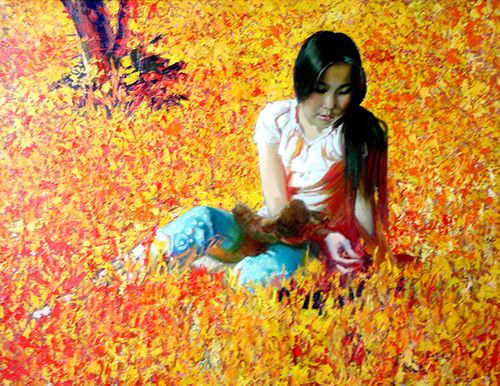
Beauty Of Autumn

Batjargal Tseintsogzol , 2005 , Oil On Canvas

Beauty of Autumn is a masterful testament to Batjargal Tseintsogzol’s command of Photorealism and his deep-seated connection to the Mongolian landscape. Painted in 2005, this oil-on-canvas work measures 70 x 90 cm, offering a window into a serene, golden moment captured with startling clarity.

Visual Composition and Style

The painting exemplifies the Realist tradition, where Tseintsogzol moves beyond mere documentation to evoke the “soul” of the season.

  • Color Palette: The canvas is dominated by a rich spectrum of ochre, burnt orange, and deep gold. These warm tones are punctuated by the crisp, cool blues of a thinning sky or perhaps a distant stream, creating a vibrant thermal contrast that defines the Mongolian autumn.

  • Technique: Utilizing the slow-drying properties of oil, the artist employs fine brushwork to render the delicate textures of drying grass and the skeletal structure of birch or larch trees. His photorealistic approach ensures that every leaf and shadow is accounted for, giving the viewer a sense of standing physically within the scene.

  • Atmosphere: There is a profound stillness in the work. The light is soft and directional, suggesting the low sun of a late afternoon. This lighting casts long, gentle shadows that provide depth and a sense of fleeting time.

Context and Legacy

Born in Ulaanbaatar, Tseintsogzol became one of Mongolia’s most respected contemporary realists. His work often sought to preserve the untouched purity of his homeland.

  • Nature as Subject: In Beauty of Autumn, nature isn’t just a backdrop; it is the protagonist. The absence of human figures emphasizes the vastness and the quiet dignity of the Mongolian wilderness.

  • Cultural Resonance: For a Mongolian artist, autumn is a season of transition and preparation. Tseintsogzol captures this “golden hour” of the year with a technical precision that honors the rugged beauty of the steppe.

“His work doesn’t just show you a place; it makes you feel the temperature of the air and the crunch of the earth.”
  • Batjargal Tseintsogzol
  • Photorealism, Portrait, Realism
  • Oil On Canvas
  • BTJ8/034
  • 70 x 90cm

Add Your Comment

Mongolian Art Gallery © 2025. All Rights Reserved
Privacy Policy / Terms of Use

Beauty of Autumn is a masterful testament to Batjargal Tseintsogzol’s command of Photorealism and his deep-seated connection to the Mongolian landscape. Painted in 2005, this oil-on-canvas work measures 70 x 90 cm, offering a window into a serene, golden moment captured with startling clarity.

Visual Composition and Style

The painting exemplifies the Realist tradition, where Tseintsogzol moves beyond mere documentation to evoke the “soul” of the season.

  • Color Palette: The canvas is dominated by a rich spectrum of ochre, burnt orange, and deep gold. These warm tones are punctuated by the crisp, cool blues of a thinning sky or perhaps a distant stream, creating a vibrant thermal contrast that defines the Mongolian autumn.

  • Technique: Utilizing the slow-drying properties of oil, the artist employs fine brushwork to render the delicate textures of drying grass and the skeletal structure of birch or larch trees. His photorealistic approach ensures that every leaf and shadow is accounted for, giving the viewer a sense of standing physically within the scene.

  • Atmosphere: There is a profound stillness in the work. The light is soft and directional, suggesting the low sun of a late afternoon. This lighting casts long, gentle shadows that provide depth and a sense of fleeting time.

Context and Legacy

Born in Ulaanbaatar, Tseintsogzol became one of Mongolia’s most respected contemporary realists. His work often sought to preserve the untouched purity of his homeland.

  • Nature as Subject: In Beauty of Autumn, nature isn’t just a backdrop; it is the protagonist. The absence of human figures emphasizes the vastness and the quiet dignity of the Mongolian wilderness.

  • Cultural Resonance: For a Mongolian artist, autumn is a season of transition and preparation. Tseintsogzol captures this “golden hour” of the year with a technical precision that honors the rugged beauty of the steppe.

“His work doesn’t just show you a place; it makes you feel the temperature of the air and the crunch of the earth.”