
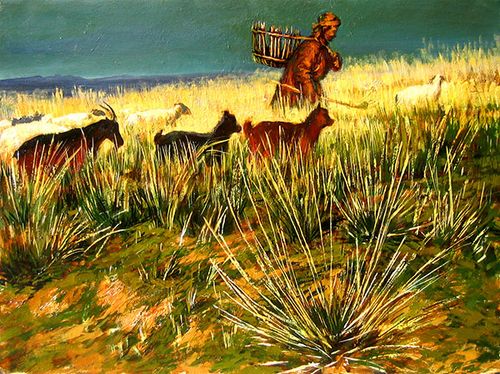
In Mongolian Life, Tseintsogzol utilizes his signature photorealistic technique to bridge the gap between documentary photography and fine art. Despite its modest dimensions (30 x 40.2 cm), the painting carries immense scale, likely focusing on the interplay between the nomadic people of Mongolia and the vast, unforgiving landscape they inhabit.
Atmospheric Realism: The artist is known for his meticulous attention to lighting. In this work, the light often feels filtered through the dusty or crisp air of the steppes, highlighting the textures of weathered skin, heavy felt gers (yurts), and the coarse fur of livestock.
Color Palette: Expect a grounding palette of earth tones—ochres, deep browns, and muted greys—punctuated by the vibrant blues of the Mongolian sky or the traditional “Deel” (tunic) worn by his subjects.
The Subject: True to the title, the painting likely avoids the “exoticized” view of nomadic life, instead opting for a quiet, candid moment. Whether it depicts a solitary herder or a family gathering, the focus remains on the resilience and harmony of life in Ulaanbaatar’s surrounding provinces.
The Artist’s Legacy
Born in Ulaanbaatar, Batjargal Tseintsogzol became a pivotal figure in contemporary Mongolian art. His work is celebrated for its ability to capture the “soul” of the landscape without falling into sentimentality. By applying the precision of Western realism to uniquely Mongolian themes, he provided a window into a culture that is simultaneously ancient and evolving.
“His paintings do not just show you a place; they make you feel the temperature of the wind and the silence of the plains.”