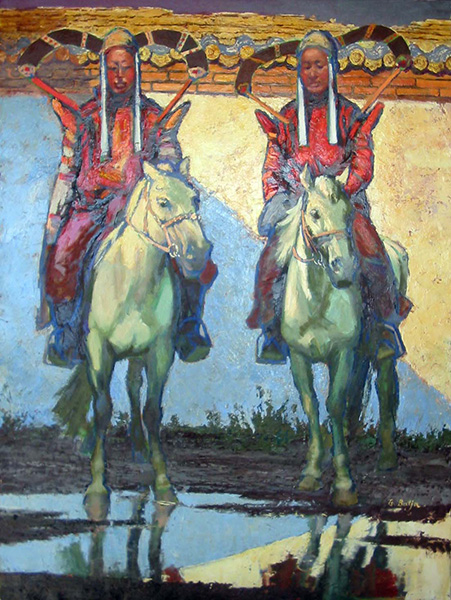
Light & Shadow

Batjargal Tseintsogzol , 2004 , Oil On Canvas

Light & Shadow (2004) is a masterful oil-on-canvas study by the renowned Mongolian artist Batjargal Tseintsogzol (1966–2020). Measuring 59 x 79 cm, this piece serves as a cornerstone of modern Mongolian Photorealism, capturing the quiet, rugged essence of the Central Asian landscape with clinical precision and deep emotional resonance.

Visual Analysis

The painting is a profound exploration of contrast, both literal and metaphorical. Tseintsogzol utilizes his background in Realism to elevate a simple natural scene into a dramatic narrative of the Mongolian wilderness.

  • Composition & Lighting: True to its title, the work hinges on the interplay between harsh, direct sunlight and deep, cool shadows. The artist employs a low-angle light source, likely mimicking the “golden hour” of the Mongolian steppe, which elongates shadows and emphasizes the tactile textures of the earth and flora.

  • Technique: Tseintsogzol’s photorealistic approach is evident in the obsessive detail of the foreground. Every blade of hardy grass and the granular texture of the soil is rendered with such clarity that the viewer can almost sense the dry, crisp air of the high-altitude environment.

  • Color Palette: The palette is dominated by earthy ochres, burnt sienna, and deep umbers, contrasted against the sharp, cool blues or muted greys found in the shadowed regions. This color story reinforces the “Nature” style associated with his work—unvarnished and unapologetically raw.

Context and Legacy

Born in Ulaanbaatar, Tseintsogzol became a pivotal figure in moving Mongolian art beyond traditional folk motifs toward a sophisticated, globalized Realism.

  • The Mongolian Identity: While the style is Western-influenced Photorealism, the soul of the painting is inherently Mongolian. It captures the “emptiness” and vastness that define the region’s geography.

  • Emotional Weight: There is a meditative stillness in Light & Shadow. By stripping away human figures or man-made structures, Tseintsogzol invites the viewer to reflect on the permanence of the land versus the fleeting nature of light.
  • Batjargal Tseintsogzol
  • Modern/Minimalist, Mongolian Style, Sculpture
  • Oil On Canvas
  • BTJ8/027
  • 59 x 79cm

Add Your Comment

Mongolian Art Gallery © 2025. All Rights Reserved
Privacy Policy / Terms of Use

Light & Shadow (2004) is a masterful oil-on-canvas study by the renowned Mongolian artist Batjargal Tseintsogzol (1966–2020). Measuring 59 x 79 cm, this piece serves as a cornerstone of modern Mongolian Photorealism, capturing the quiet, rugged essence of the Central Asian landscape with clinical precision and deep emotional resonance.

Visual Analysis

The painting is a profound exploration of contrast, both literal and metaphorical. Tseintsogzol utilizes his background in Realism to elevate a simple natural scene into a dramatic narrative of the Mongolian wilderness.

  • Composition & Lighting: True to its title, the work hinges on the interplay between harsh, direct sunlight and deep, cool shadows. The artist employs a low-angle light source, likely mimicking the “golden hour” of the Mongolian steppe, which elongates shadows and emphasizes the tactile textures of the earth and flora.

  • Technique: Tseintsogzol’s photorealistic approach is evident in the obsessive detail of the foreground. Every blade of hardy grass and the granular texture of the soil is rendered with such clarity that the viewer can almost sense the dry, crisp air of the high-altitude environment.

  • Color Palette: The palette is dominated by earthy ochres, burnt sienna, and deep umbers, contrasted against the sharp, cool blues or muted greys found in the shadowed regions. This color story reinforces the “Nature” style associated with his work—unvarnished and unapologetically raw.

Context and Legacy

Born in Ulaanbaatar, Tseintsogzol became a pivotal figure in moving Mongolian art beyond traditional folk motifs toward a sophisticated, globalized Realism.

  • The Mongolian Identity: While the style is Western-influenced Photorealism, the soul of the painting is inherently Mongolian. It captures the “emptiness” and vastness that define the region’s geography.

  • Emotional Weight: There is a meditative stillness in Light & Shadow. By stripping away human figures or man-made structures, Tseintsogzol invites the viewer to reflect on the permanence of the land versus the fleeting nature of light.