
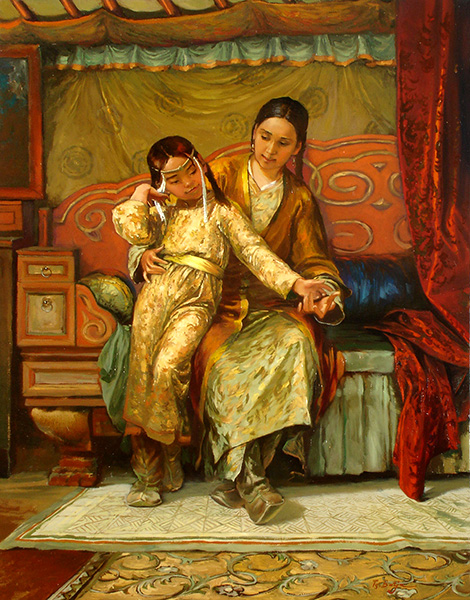
Little Beauty is a masterful example of contemporary Mongolian photorealism, captured by the late Batjargal Tseintsogzol. Painted in 2007, this oil-on-canvas work measures 80 x 60cm and serves as a poignant intersection of traditional Mongolian identity and meticulous technical execution.
Visual Composition and Style
The painting leans heavily into Photorealism, a style Tseintsogzol was renowned for within the Mongolian art scene. Every fiber of the subject’s traditional attire and the subtle textures of the skin are rendered with a clarity that rivals high-resolution photography.
The Subject: The work features a young girl, likely of nomadic heritage, whose expression captures a blend of innocence and stoic resilience typical of the Mongolian steppe’s inhabitants.
The Palette: Tseintsogzol utilizes a rich, earthy color palette. The warm tones of the skin contrast beautifully with the vibrant, detailed patterns of the deel (traditional Mongolian tunic).
Light and Shadow: The artist employs soft, directional lighting that creates a gentle depth, highlighting the “Little Beauty’s” features while grounding her in a space that feels both intimate and expansive.
Cultural Context
Born in Ulaanbaatar, Tseintsogzol spent his career bridging the gap between the rapid modernization of Mongolia and its deep-rooted nomadic traditions. In Little Beauty, the Realism & Nature influences are evident not through a literal landscape, but through the organic textures of the clothing and the natural, unposed grace of the child.
The painting is more than a portrait; it is a preservation of a moment in time, reflecting the dignity and quiet grace of the Mongolian people during the early 21st century.