
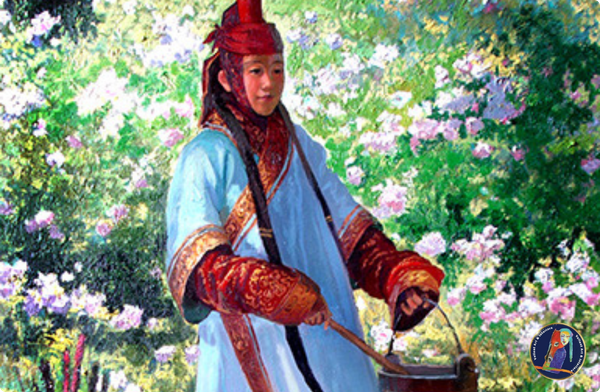
Oulan Mother

Batjargal Tseintsogzol , 2006 , Oil On Canvas

Oulan “Mother” is a poignant masterwork by the late Mongolian artist Batjargal Tseintsogzol. Painted in 2006, this oil-on-canvas piece stands as a testament to the artist’s technical precision and his deep emotional connection to the cultural identity of Mongolia.

Visual Overview

The painting measures 79 x 50 cm, a vertical orientation that emphasizes the dignified stature of its subject. Rendered in a style that bridges Photorealism and Classical Realism, the work depicts an elderly Mongolian woman—the “Mother”—whose face serves as a topographical map of a life lived in the vast, unforgiving, and beautiful landscapes of Central Asia.

Composition and Style

  • The Subject: The woman is often depicted with a weathered complexion, her skin textured with fine lines that Tseintsogzol captures with microscopic detail. This high-fidelity approach (Photorealism) ensures that every wrinkle and pore tells a story of resilience.

  • Lighting & Color: The artist utilizes soft, naturalistic lighting that mimics the high-altitude sun of Ulaanbaatar. The palette typically favors earthy tones—deep ochres, weathered browns, and soft crimsons—reflecting the traditional attire and the natural environment of Mongolia.

  • Emotional Depth: While the technical skill is immense, the soul of the painting lies in the subject’s expression. There is a sense of quietude and enduring strength, a hallmark of Tseintsogzol’s “Nature” influence, where humanity is seen as an extension of the earth itself.

About the Artist: Batjargal Tseintsogzol (1966–2020)

Born in Ulaanbaatar, Tseintsogzol became one of Mongolia’s most respected contemporary realists. His work often focused on the intersection of human dignity and the natural world.

  • Cultural Legacy: He was known for capturing the “vanishing” traditional life of Mongolia. His portraits are not merely likenesses but are considered cultural archives.

  • Technique: His ability to manipulate oil paint to mimic the textures of wool, skin, and leather earned him international acclaim within the realism movement.

  • Batjargal Tseintsogzol
  • Realism, Sculpture, Still Life
  • Oil On Canvas
  • BTJ8/013
  • 79 x 50cm

Add Your Comment

Mongolian Art Gallery © 2025. All Rights Reserved
Privacy Policy / Terms of Use

Oulan “Mother” is a poignant masterwork by the late Mongolian artist Batjargal Tseintsogzol. Painted in 2006, this oil-on-canvas piece stands as a testament to the artist’s technical precision and his deep emotional connection to the cultural identity of Mongolia.

Visual Overview

The painting measures 79 x 50 cm, a vertical orientation that emphasizes the dignified stature of its subject. Rendered in a style that bridges Photorealism and Classical Realism, the work depicts an elderly Mongolian woman—the “Mother”—whose face serves as a topographical map of a life lived in the vast, unforgiving, and beautiful landscapes of Central Asia.

Composition and Style

  • The Subject: The woman is often depicted with a weathered complexion, her skin textured with fine lines that Tseintsogzol captures with microscopic detail. This high-fidelity approach (Photorealism) ensures that every wrinkle and pore tells a story of resilience.

  • Lighting & Color: The artist utilizes soft, naturalistic lighting that mimics the high-altitude sun of Ulaanbaatar. The palette typically favors earthy tones—deep ochres, weathered browns, and soft crimsons—reflecting the traditional attire and the natural environment of Mongolia.

  • Emotional Depth: While the technical skill is immense, the soul of the painting lies in the subject’s expression. There is a sense of quietude and enduring strength, a hallmark of Tseintsogzol’s “Nature” influence, where humanity is seen as an extension of the earth itself.

About the Artist: Batjargal Tseintsogzol (1966–2020)

Born in Ulaanbaatar, Tseintsogzol became one of Mongolia’s most respected contemporary realists. His work often focused on the intersection of human dignity and the natural world.

  • Cultural Legacy: He was known for capturing the “vanishing” traditional life of Mongolia. His portraits are not merely likenesses but are considered cultural archives.

  • Technique: His ability to manipulate oil paint to mimic the textures of wool, skin, and leather earned him international acclaim within the realism movement.