

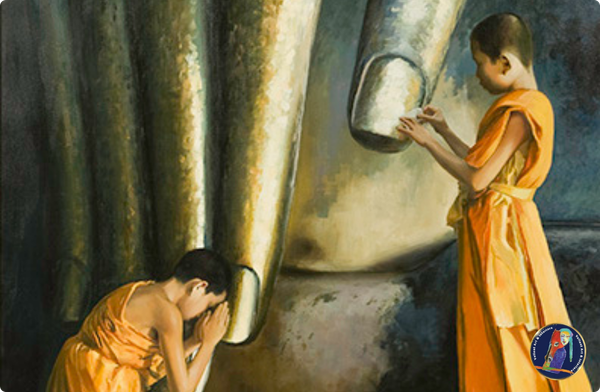
At $136 \times 91$ cm, the painting possesses a vertical presence that mirrors the upward, spiritual yearning of its subject matter. Tseintsogzol, a master of Photorealism, utilizes light and shadow to create a tactile sense of reality.
The Subject: The title, which translates roughly to “Praying Beneath the God” or “Bowing Before the Sacred,” suggests a scene of profound devotion.
Technique: Tseintsogzol’s background in Realism is evident in the rendering of textures—whether it is the weathered grain of wood, the soft drape of traditional silk (deels), or the subtle play of light on skin.
Atmosphere: Despite the precision of the brushwork, the piece avoids the coldness often associated with hyper-realism. Instead, it is bathed in a warm, contemplative glow, emphasizing the naturalistic beauty of Mongolian heritage.
Cultural Context
Born in Ulaanbaatar, Tseintsogzol (1966–2020) was part of a generation of Mongolian artists who bridged the gap between traditional nomadic aesthetics and modern technical mastery. In this 2006 piece, he explores:
Spirituality: The act of prayer or bowing serves as the focal point, grounding the viewer in the quiet dignity of Mongolian Buddhist or Shamanic traditions.
Nature: True to his associated styles, the “Nature” element is likely present through the depiction of organic materials or the suggestion of the vast, open landscapes that inform the Mongolian soul.
“His work does not just document a moment; it preserves the stillness and the sacred breath of Mongolian life.”
About the Artist
Batjargal Tseintsogzol was renowned for his ability to capture the “unseen” through the “seen.” His untimely passing in 2020 left a void in the Mongolian art community, but works like Burtkhan Door Murugmui remain as vital icons of the country’s enduring spirit and its transition into the 21st-century art world.
