

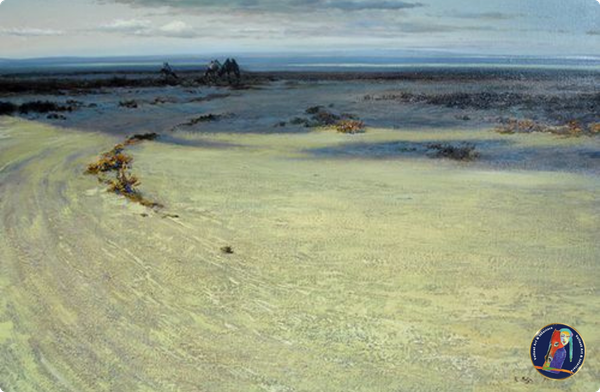
Sand (2007) is a masterclass in the Photorealist tradition, captured by the late Mongolian artist Batjargal Tseintsogzol. Measuring 60 x 80 cm, this oil-on-canvas work exemplifies the artist’s profound ability to find the sublime within the minimalist landscapes of his homeland.
Visual Composition and Style
The painting is an intimate study of the Mongolian desert, executed with such precision that it transcends simple representation and enters the realm of Photorealism. Tseintsogzol bypasses the grand, sweeping vistas often associated with the Gobi, choosing instead to focus on the rhythmic, undulating patterns of sand dunes.
Texture and Detail: Every grain and ripple is rendered with meticulous care. The artist uses subtle gradations of light and shadow to define the sharp crests of the dunes, giving the canvas a tactile, three-dimensional quality.
Palette: The color scheme is a sophisticated exploration of ochre, gold, and soft tan. These warm tones are contrasted by the deep, cool shadows that pool in the valleys of the dunes, suggesting the harsh, low-angled light of a rising or setting sun.
Atmosphere: Despite the stillness of the subject, there is an inherent sense of movement—a “frozen” moment of wind-swept Earth. The lack of human or animal presence imbues the work with a meditative, almost spiritual silence.
About the Artist: Batjargal Tseintsogzol (1966–2020)
Born in Ulaanbaatar, Tseintsogzol was a pivotal figure in contemporary Mongolian art. His work often bridged the gap between traditional Mongolian reverence for nature and modern Western techniques of Realism.
In Sand, Tseintsogzol doesn’t just paint a landscape; he captures the “spirit of place.” His legacy remains defined by this ability to take the seemingly mundane—shifting dirt and light—and elevate it into a profound observation of the natural world’s endurance.
