

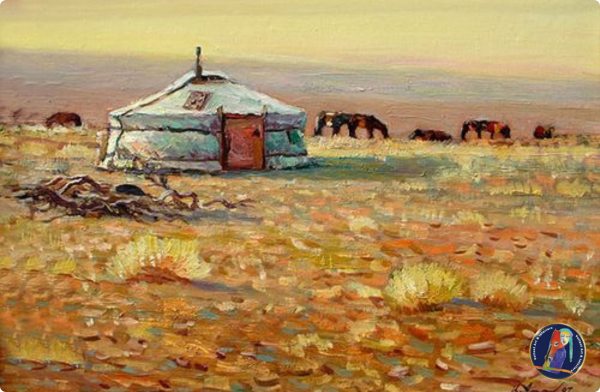
Neighbour is an intimate, minimalist exploration of space and relationship, captured through Ayush Tseren’s signature restrained palette and focus on the Mongolian landscape. Created in 2006, this oil-on-canvas work utilizes a modest horizontal format ($33 \times 46\text{ cm}$) to evoke a sense of quietude and the vast distances inherent to nomadic life.
Composition and Style
The painting is characterized by its stark, modern simplicity. Rather than a busy narrative, Tseren focuses on the placement of forms within an expansive environment. The composition likely features:
Spatial Harmony: The “neighbour” of the title is suggested through the placement of two primary subjects—perhaps gers (traditional dwellings) or lone figures—separated by a significant but meaningful stretch of the steppe.
Minimalist Texture: Consistent with the artist’s style from this period, the oil application is likely smooth yet intentional, using subtle tonal shifts to define the horizon and the soft contours of the earth.
Muted Palette: The color scheme likely draws from earthy ochres, soft greys, and pale sky blues, reflecting the natural light of the high plateau.
Symbolism and Tone
The title Neighbour carries a poignant weight in the context of the Mongolian wilderness. It redefines “closeness” not by physical proximity, but by the shared experience of the environment.
Solitude vs. Connection: The painting captures the balance between individual independence and the comfort of knowing someone else is present in the vastness.
Timelessness: By stripping away modern distractions, Tseren achieves a timeless quality that speaks to the enduring nature of human connection and the land.
Interior Placement Suggestion
Due to its smaller dimensions and calming subject matter, this piece is ideally suited for:
A minimalist study or home office, where its sense of balance can foster focus.
Part of a curated gallery wall, paired with other works from Tseren’s 2006 series (such as Nature or Steppe) to create a narrative of the Mongolian landscape.