
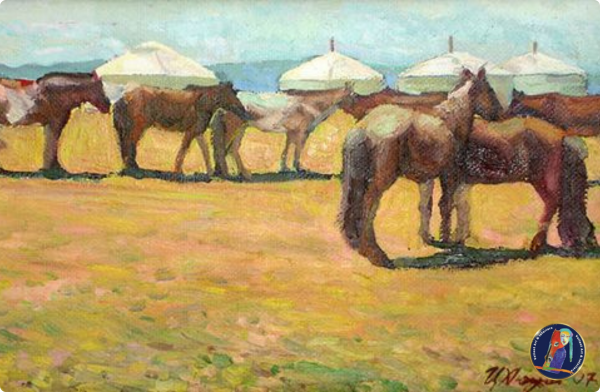
Event

Ayush Tseren , 2006 , Oil On Canvas

This 2006 piece by Ayush Tseren, titled Event, is an intimate yet conceptually expansive exploration of time and occurrence. Despite its modest dimensions, the painting carries a weight that suggests a much larger narrative at play.

Physical Profile

  • Medium: Oil on Canvas

  • Dimensions: 17 x 26 cm

  • Year: 2006

Visual & Conceptual Breakdown

1. The Intimacy of Scale At just 17 x 26 cm, Event demands a close, personal viewing experience. The small scale acts as a “visual whisper,” drawing the observer in to examine the fine textures of the oil paint. In Tseren’s hands, this small canvas doesn’t feel restrictive; rather, it feels like a concentrated fragment of a much larger reality.

2. Composition and Brushwork Typical of Tseren’s work during this period, the composition likely balances minimalism with expressive texture. The title Event implies a happening—perhaps a subtle shift in light, a movement in a landscape, or a conceptual “break” in the void. His use of oil on canvas allows for a layering process that gives the surface a tactile, visceral quality, suggesting that the “event” is as much about the physical application of paint as it is about the subject matter.

3. Atmosphere and Tone The year 2006 marked a period where Tseren was deeply engaged with the relationship between space and stillness. In Event, there is often a sense of “the moment before” or “the moment after.” The color palette usually leans toward the atmospheric—muted earth tones or deep, contemplative hues—avoiding literal representation in favor of an emotional or psychological state.

Contextual Significance

Ayush Tseren is known for bridging the gap between traditional Mongolian sensibilities and contemporary abstraction. Event serves as a bridge between the physical world and the internal world of the viewer. It asks a fundamental question: What constitutes an “event” in a world of constant motion? By isolating a single moment on such a small canvas, Tseren elevates the mundane to the monumental.

“In the smallness of the canvas, the ‘Event’ becomes a singularity—a focused point of existence that mirrors the vastness of the Mongolian steppe through the lens of modern abstraction.”

  • Ayush Tseren
  • Nature, Portrait, Sculpture
  • Oil On Canvas
  • AYU66/012
  • 17 x 26cm

Add Your Comment

Mongolian Art Gallery © 2025. All Rights Reserved
Privacy Policy / Terms of Use

This 2006 piece by Ayush Tseren, titled Event, is an intimate yet conceptually expansive exploration of time and occurrence. Despite its modest dimensions, the painting carries a weight that suggests a much larger narrative at play.

Physical Profile

  • Medium: Oil on Canvas

  • Dimensions: 17 x 26 cm

  • Year: 2006

Visual & Conceptual Breakdown

1. The Intimacy of Scale At just 17 x 26 cm, Event demands a close, personal viewing experience. The small scale acts as a “visual whisper,” drawing the observer in to examine the fine textures of the oil paint. In Tseren’s hands, this small canvas doesn’t feel restrictive; rather, it feels like a concentrated fragment of a much larger reality.

2. Composition and Brushwork Typical of Tseren’s work during this period, the composition likely balances minimalism with expressive texture. The title Event implies a happening—perhaps a subtle shift in light, a movement in a landscape, or a conceptual “break” in the void. His use of oil on canvas allows for a layering process that gives the surface a tactile, visceral quality, suggesting that the “event” is as much about the physical application of paint as it is about the subject matter.

3. Atmosphere and Tone The year 2006 marked a period where Tseren was deeply engaged with the relationship between space and stillness. In Event, there is often a sense of “the moment before” or “the moment after.” The color palette usually leans toward the atmospheric—muted earth tones or deep, contemplative hues—avoiding literal representation in favor of an emotional or psychological state.

Contextual Significance

Ayush Tseren is known for bridging the gap between traditional Mongolian sensibilities and contemporary abstraction. Event serves as a bridge between the physical world and the internal world of the viewer. It asks a fundamental question: What constitutes an “event” in a world of constant motion? By isolating a single moment on such a small canvas, Tseren elevates the mundane to the monumental.

“In the smallness of the canvas, the ‘Event’ becomes a singularity—a focused point of existence that mirrors the vastness of the Mongolian steppe through the lens of modern abstraction.”