10th – 13th Century Aristocrat

Amarsanaa Galmandakh , 2005 , Oil On Canvas

Subject and Composition


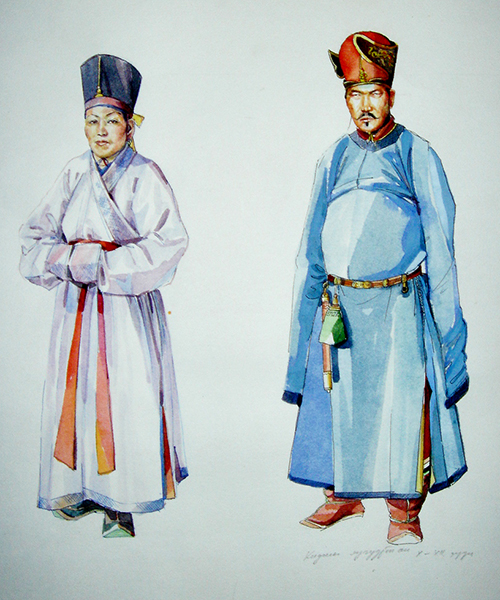
The painting features two figures—a woman and a man—standing side-by-side in formal attire, representing the aristocratic fashion of the early Mongolian period. Both figures are presented frontally against a light, neutral background, allowing the detail of their clothing to be the central focus.

Attire and Significance


The clothing is likely based on historical and archaeological research into the early forms of the Deel (Mongolian traditional robe) and ceremonial court dress, particularly before the full incorporation of Central Asian and Chinese silk traditions.

  • The Female Aristocrat (Left):

    • She wears a long, wide-sleeved white robe (Deel), which is simple yet elegant, suggesting high quality fabric like silk or fine wool, often reserved for the elite. The robe is secured with a sash.

    • She is topped by a distinctive tall, cylindrical black hat with a slightly flared brim, a style of headwear historically associated with status and courtly formality. Her hands are held modestly, folded within the sleeves, a posture common in traditional East Asian court etiquette.

  • The Male Aristocrat (Right):

    • He wears a voluminous blue robe (Deel) with wide sleeves, fastened on the right side of the chest, a hallmark of traditional Mongolian and Central Asian nomadic clothing. A patterned sash is visible at the waist.

    • His headwear is a tall, conical or tiered hat in red and gold, possibly representing felt and silk brocade, further distinguishing his noble status.

    • Details like the decorative pouch or accessory hanging from his belt and his sturdy, bright red boots complete the ensemble, emphasizing his wealth and social standing.

Style and Interpretation


Executed in watercolor, the artist uses the medium to highlight the richness of the fabric colors (especially the bright blues, reds, and white) while maintaining a sense of historical accuracy in the cut and form of the robes. The painting is a valuable historical document, interpreting the formal, nomadic elegance of the early Mongol aristocracy.

75% Embellish

You will get exact same copy of the original
$ 1000
  • Premium Look
  • 100% original
Premium

50% Embellish

$650

30% Embellish

$500

  • Amarsanaa Galmandakh
  • Early 21st Century
  • Abstract, Figurative, Modern/Contemporary, Mongolian Style, Nude, Portrait
  • Oil on canvas
  • AMR1/012
  • 33 x 32cm13" x 12"
  • Mongolian Art Gallery

Add Your Comment

Mongolian Art Gallery © 2025. All Rights Reserved
Privacy Policy / Terms of Use

Subject and Composition


The painting features two figures—a woman and a man—standing side-by-side in formal attire, representing the aristocratic fashion of the early Mongolian period. Both figures are presented frontally against a light, neutral background, allowing the detail of their clothing to be the central focus.

Attire and Significance


The clothing is likely based on historical and archaeological research into the early forms of the Deel (Mongolian traditional robe) and ceremonial court dress, particularly before the full incorporation of Central Asian and Chinese silk traditions.

  • The Female Aristocrat (Left):

    • She wears a long, wide-sleeved white robe (Deel), which is simple yet elegant, suggesting high quality fabric like silk or fine wool, often reserved for the elite. The robe is secured with a sash.

    • She is topped by a distinctive tall, cylindrical black hat with a slightly flared brim, a style of headwear historically associated with status and courtly formality. Her hands are held modestly, folded within the sleeves, a posture common in traditional East Asian court etiquette.

  • The Male Aristocrat (Right):

    • He wears a voluminous blue robe (Deel) with wide sleeves, fastened on the right side of the chest, a hallmark of traditional Mongolian and Central Asian nomadic clothing. A patterned sash is visible at the waist.

    • His headwear is a tall, conical or tiered hat in red and gold, possibly representing felt and silk brocade, further distinguishing his noble status.

    • Details like the decorative pouch or accessory hanging from his belt and his sturdy, bright red boots complete the ensemble, emphasizing his wealth and social standing.

Style and Interpretation


Executed in watercolor, the artist uses the medium to highlight the richness of the fabric colors (especially the bright blues, reds, and white) while maintaining a sense of historical accuracy in the cut and form of the robes. The painting is a valuable historical document, interpreting the formal, nomadic elegance of the early Mongol aristocracy.

75% Embellish

You will get exact same copy of the original
$ 1000
  • Premium Look
  • 100% original
Premium

50% Embellish

$650

30% Embellish

$500