Ovoo

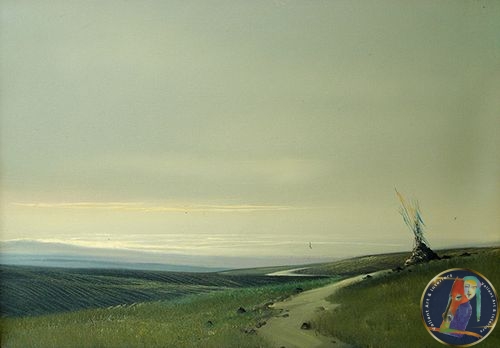
Khurelbaatar Choindon , 2006 , Oil On Canvas

In this 2006 oil on canvas, Khurelbaatar Choindon utilizes his rigorous academic training from the Repin Academy of Fine Art to present a masterful example of Photorealism and Contemporary Realism. The work, titled Ovoo, serves as both a landscape study and a cultural document of Mongolian spiritual life.

Visual Composition and Subject Matter

The painting centers on an ovoo—a sacred cairn found in Mongolian Buddhist and Shamanic traditions. Choindon renders the structure with painstaking detail, depicting a conical heap of weathered stones and earth.

  • The Textures: The artist demonstrates his technical prowess by capturing the tactile contrast between the rugged, jagged edges of the rocks and the soft, flowing textures of the khadag (ceremonial silk scarves). These blue scarves, bleached and frayed by the harsh Mongolian winds, are draped around the wooden poles protruding from the center of the cairn.

  • The Palette: The color scheme is grounded in an earthy, naturalistic palette. Muted ochres, dusty browns, and slate grays dominate the foreground, while the vibrant blue of the scarves provides a striking focal point, echoing the vast Mongolian sky.

Style and Technique

Reflecting the Leningrad School of Painting influence, Choindon employs a sophisticated use of light and atmosphere.

  • Atmospheric Perspective: The background features a sweeping, desolate landscape that recedes into soft, hazy horizons. This creates a profound sense of isolation and immense scale, typical of the Mongolian steppe.

  • Precision and Light: Every pebble and fiber of silk is treated with equal importance. The light source is natural and diffused, suggesting the thin, clear air of a high-altitude environment. There is no dramatization; instead, the beauty is found in the stark, honest reality of the scene.


Cultural Significance

As a figurehead in the Union of Mongolian Artists (UMA), Choindon often explores themes of national identity. In Ovoo, the painting transcends mere landscape. It represents:

  • Veneration of Nature: The ovoo is a point of contact between the human and the divine.

  • Endurance: The weathered state of the shrine speaks to the persistence of tradition amidst a vast, unchanging wilderness.

Measuring $36 \times 51\text{ cm}$, the painting offers an intimate yet expansive window into the soul of the Mongolian countryside, characterized by a quiet, meditative stillness.
  • Khurelbaatar Choindon
  • Figurative, Nature, Realism
  • Oil On Canvas
  • KBR31/0440
  • 36 x 51cm
  • Mongolian Art Gallery

Add Your Comment

Mongolian Art Gallery © 2025. All Rights Reserved
Privacy Policy / Terms of Use

In this 2006 oil on canvas, Khurelbaatar Choindon utilizes his rigorous academic training from the Repin Academy of Fine Art to present a masterful example of Photorealism and Contemporary Realism. The work, titled Ovoo, serves as both a landscape study and a cultural document of Mongolian spiritual life.

Visual Composition and Subject Matter

The painting centers on an ovoo—a sacred cairn found in Mongolian Buddhist and Shamanic traditions. Choindon renders the structure with painstaking detail, depicting a conical heap of weathered stones and earth.

  • The Textures: The artist demonstrates his technical prowess by capturing the tactile contrast between the rugged, jagged edges of the rocks and the soft, flowing textures of the khadag (ceremonial silk scarves). These blue scarves, bleached and frayed by the harsh Mongolian winds, are draped around the wooden poles protruding from the center of the cairn.

  • The Palette: The color scheme is grounded in an earthy, naturalistic palette. Muted ochres, dusty browns, and slate grays dominate the foreground, while the vibrant blue of the scarves provides a striking focal point, echoing the vast Mongolian sky.

Style and Technique

Reflecting the Leningrad School of Painting influence, Choindon employs a sophisticated use of light and atmosphere.

  • Atmospheric Perspective: The background features a sweeping, desolate landscape that recedes into soft, hazy horizons. This creates a profound sense of isolation and immense scale, typical of the Mongolian steppe.

  • Precision and Light: Every pebble and fiber of silk is treated with equal importance. The light source is natural and diffused, suggesting the thin, clear air of a high-altitude environment. There is no dramatization; instead, the beauty is found in the stark, honest reality of the scene.


Cultural Significance

As a figurehead in the Union of Mongolian Artists (UMA), Choindon often explores themes of national identity. In Ovoo, the painting transcends mere landscape. It represents:

  • Veneration of Nature: The ovoo is a point of contact between the human and the divine.

  • Endurance: The weathered state of the shrine speaks to the persistence of tradition amidst a vast, unchanging wilderness.

Measuring $36 \times 51\text{ cm}$, the painting offers an intimate yet expansive window into the soul of the Mongolian countryside, characterized by a quiet, meditative stillness.