
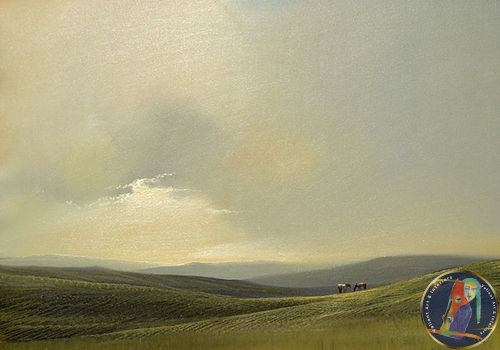
In this intimate 2006 oil painting, Khurelbaatar Choindon leverages his mastery of photorealism and figurative art to capture a quiet, atmospheric moment between two horses. Despite the relatively small scale of the canvas ($36 \times 50\text{ cm}$), the work conveys the vastness of the Mongolian landscape through a minimalist yet highly detailed lens.
The Subjects: The composition centers on two horses, rendered with the anatomical precision characteristic of Choindon’s training at the Repin Academy of Fine Art. Their coats show a subtle interplay of light and shadow, highlighting the musculature and texture of their manes. The positioning of the horses—likely standing close together—suggests a sense of companionship and stillness.
The Landscape: True to his roots, the artist places the animals within a sprawling Mongolian steppe. The background is not a mere backdrop but a study in nature and realism. Choindon uses a soft, naturalistic palette to depict the horizon, where the earth meets a vast, often overcast sky, creating a sense of infinite space and quietude.
Style and Technique: The painting is a hallmark of the Mongolian “Realist” school, blending Russian academic rigor with nomadic sensibilities. The brushwork is refined and nearly invisible, typical of photorealism, allowing the viewer to focus on the emotional weight of the scene rather than the medium itself. The lighting is diffused, evoking the cool, crisp air of the high plains.
About the Artist: Khurelbaatar Choindon
Khurelbaatar Choindon (b. 1959) is a preeminent figure in contemporary Mongolian art, known for his ability to translate the soul of the steppe onto canvas.
Academic Pedigree: His style was forged through elite training, first at the College of Fine Art in Ulaanbaatar and later at the prestigious Repin Academy in St. Petersburg. This Russian influence is evident in his structural discipline and sophisticated use of oil.
Professional Standing: Beyond his creative output, Choindon has been a pillar of the Mongolian art community, serving as the Vice Chairman of the Union of Mongolian Artists (UMA) since 2001.
Global Recognition: His work has been exhibited extensively across the globe, from the Fukuoka Art Museum in Japan to galleries in Washington D.C., Amsterdam, and Prague. His exhibitions highlight a career dedicated to bridging the gap between traditional Mongolian subjects and world-class realist techniques.
Summary of Style
Choindon’s Two Horses is more than a nature study; it is a testament to the Figurative and Landscape traditions. By focusing on the horse—a symbol of Mongolian identity—with such meticulous detail, he elevates the subject from a simple animal to a monumental presence within the natural world.