Mongol Ger

Khurelbaatar Choindon , 2006 , Oil On Canvas

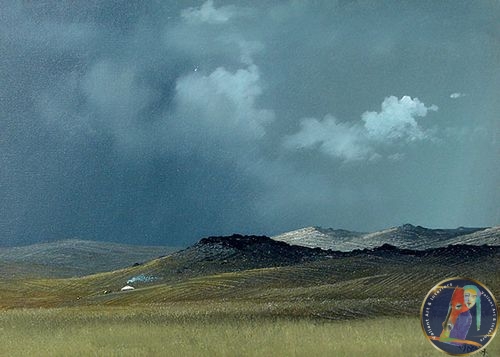
Khurelbaatar Choindon’s 2006 masterpiece, Mongol Ger, is a quintessential example of contemporary Mongolian photorealism. Painted in oil on a 36 x 50cm canvas, the work captures a profound sense of stillness and cultural heritage through a meticulous lens.

Visual Composition and Subject Matter

The painting focuses on the traditional Mongolian dwelling, the Ger (yurt), set against the vast, atmospheric backdrop of the steppe. Choindon utilizes his classical training from the Repin Academy of Fine Art to render textures with breathtaking accuracy.

  • The Ger: The central subject is depicted with structural integrity. The viewer can almost feel the heavy, sun-bleached felt covering and the tension of the ropes securing the structure. The play of light across the curved surface of the Ger creates a tangible sense of volume and three-dimensionality.

  • The Landscape: True to the artist’s association with nature and landscape styles, the environment is not merely a background but a character itself. The horizon line is often placed to emphasize the “Eternal Blue Sky,” while the foreground captures the rugged, sparse vegetation of the Mongolian plateau with granular detail.

  • Lighting and Atmosphere: The work is bathed in a soft, naturalistic light—likely the golden hour—which casts long, subtle shadows. This lighting choice enhances the photorealistic quality, making the scene feel less like a stylized painting and more like a captured moment in time.

Artistic Style and Technique

Choindon’s style in this piece sits at the intersection of Realism and Figurative Landscape.

  • Photorealism: Every blade of grass and every ripple in the Ger’s canvas is accounted for. There is a lack of visible brushstrokes, suggesting a highly disciplined, smooth application of oil paint that mimics the clarity of a high-resolution photograph.

  • Cultural Narrative: While the painting is a landscape, it is inherently figurative in its depiction of human life. The Ger serves as a symbol of the nomadic soul, resilience, and the harmonious balance between man and the harsh Mongolian environment.

About the Artist: Khurelbaatar Choindon

Born in 1959, Choindon is a pivotal figure in the Mongolian art scene, serving as the Vice Chairman of the Union of Mongolian Artists (UMA) since 2001.

His education in both Ulaanbaatar and St. Petersburg provided him with a rigorous technical foundation in European academic traditions, which he successfully synthesized with Mongolian themes. His international exhibition history—spanning from Washington and Tokyo to Amsterdam—underscores the universal appeal of his hyper-focused, serene depictions of Mongolian life.


Summary: Mongol Ger is more than a technical exercise in photorealism; it is a quiet, powerful tribute to the Mongolian way of life, characterized by a masterful control of light, texture, and spatial composition.
  • Khurelbaatar Choindon
  • Landscape, Mongolian Style, Nature
  • Oil On Canvas
  • KBR31/042
  • 36 x 50cm
  • Mongolian Art Gallery

Add Your Comment

Mongolian Art Gallery © 2025. All Rights Reserved
Privacy Policy / Terms of Use

Khurelbaatar Choindon’s 2006 masterpiece, Mongol Ger, is a quintessential example of contemporary Mongolian photorealism. Painted in oil on a 36 x 50cm canvas, the work captures a profound sense of stillness and cultural heritage through a meticulous lens.

Visual Composition and Subject Matter

The painting focuses on the traditional Mongolian dwelling, the Ger (yurt), set against the vast, atmospheric backdrop of the steppe. Choindon utilizes his classical training from the Repin Academy of Fine Art to render textures with breathtaking accuracy.

  • The Ger: The central subject is depicted with structural integrity. The viewer can almost feel the heavy, sun-bleached felt covering and the tension of the ropes securing the structure. The play of light across the curved surface of the Ger creates a tangible sense of volume and three-dimensionality.

  • The Landscape: True to the artist’s association with nature and landscape styles, the environment is not merely a background but a character itself. The horizon line is often placed to emphasize the “Eternal Blue Sky,” while the foreground captures the rugged, sparse vegetation of the Mongolian plateau with granular detail.

  • Lighting and Atmosphere: The work is bathed in a soft, naturalistic light—likely the golden hour—which casts long, subtle shadows. This lighting choice enhances the photorealistic quality, making the scene feel less like a stylized painting and more like a captured moment in time.

Artistic Style and Technique

Choindon’s style in this piece sits at the intersection of Realism and Figurative Landscape.

  • Photorealism: Every blade of grass and every ripple in the Ger’s canvas is accounted for. There is a lack of visible brushstrokes, suggesting a highly disciplined, smooth application of oil paint that mimics the clarity of a high-resolution photograph.

  • Cultural Narrative: While the painting is a landscape, it is inherently figurative in its depiction of human life. The Ger serves as a symbol of the nomadic soul, resilience, and the harmonious balance between man and the harsh Mongolian environment.

About the Artist: Khurelbaatar Choindon

Born in 1959, Choindon is a pivotal figure in the Mongolian art scene, serving as the Vice Chairman of the Union of Mongolian Artists (UMA) since 2001.

His education in both Ulaanbaatar and St. Petersburg provided him with a rigorous technical foundation in European academic traditions, which he successfully synthesized with Mongolian themes. His international exhibition history—spanning from Washington and Tokyo to Amsterdam—underscores the universal appeal of his hyper-focused, serene depictions of Mongolian life.


Summary: Mongol Ger is more than a technical exercise in photorealism; it is a quiet, powerful tribute to the Mongolian way of life, characterized by a masterful control of light, texture, and spatial composition.