
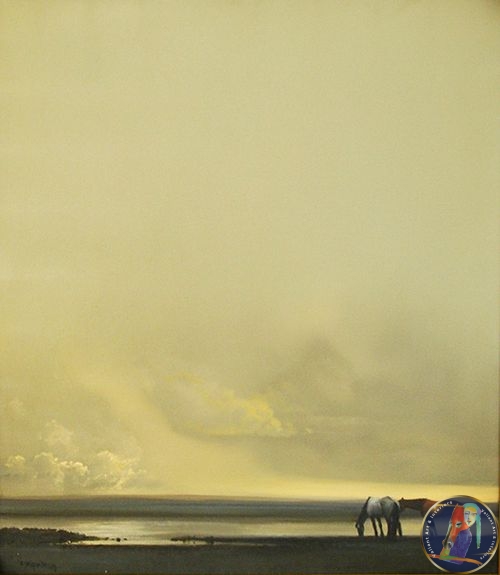
In Twin Horses, Khurelbaatar Choindon leverages his mastery of photorealism and his deep-rooted connection to the Mongolian landscape to create a work of profound stillness and technical precision. The painting depicts two horses standing in close proximity, a subject that serves as a cornerstone of Mongolian identity and artistic tradition.
True to the artist’s training at the prestigious Repin Academy of Fine Art, the anatomical rendering of the horses is impeccable. Every muscle group, the slight curve of the neck, and the texture of the coats are captured with a clarity that borders on the photographic. The horses are not merely subjects of a nature study; they are imbued with a sense of quiet companionship and “figurative” personality.
Composition and Style
The Play of Light: The lighting in the piece is soft yet directional, highlighting the sheen on the horses’ flanks and creating a sense of three-dimensional volume. This reflects Choindon’s “Realism” style, where light is used not just for visibility but to define the physical presence of the animals within the space.
Atmospheric Landscape: The background likely features the vast, rolling steppes or the muted, earthy tones characteristic of the Mongolian countryside. By using a relatively compact canvas size ($62 \times 72$ cm), Choindon focuses the viewer’s attention on the intimacy between the “Twin” subjects, rather than the overwhelming scale of the landscape.
Color Palette: Expect a sophisticated use of naturalistic earth tones—ochres, burnt sienna, and cool grays—which harmonize the animals with their environment. The brushwork, while precise in the rendering of the horses, may become more fluid and expressive in the surrounding grass and sky, a hallmark of his “Nature” and “Landscape” associations.
Artistic Context
Created in 2006, during Choindon’s tenure as the Vice Chairman of the Union of Mongolian Artists (UMA), this painting represents a mature phase of his career. It bridges the gap between the rigorous academic training he received in St. Petersburg and the nomadic spirit of his homeland. Twin Horses is less a portrait of animals and more a meditation on the harmony of nature, executed with the disciplined eye of a master realist.