
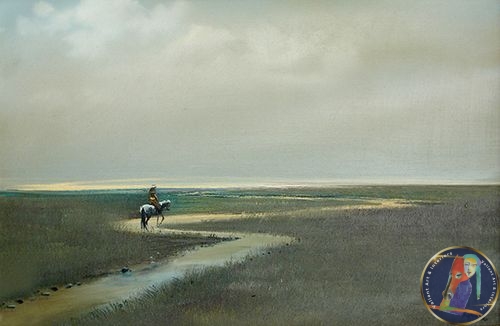
Khurelbaatar Choindon’s Herdsman is a masterclass in Photorealism and Mongolian Realism, capturing the profound, quiet relationship between man and the vast Central Asian landscape. Measuring 40 x 60 cm, the painting offers an intimate yet expansive view of nomadic life, filtered through the artist’s rigorous academic training at the Repin Academy in St. Petersburg.
Composition and Subject Matter
The painting centers on the solitary figure of a Mongolian herdsman. Choindon utilizes a figurative approach that emphasizes the weathered texture of the subject’s clothing and skin, suggesting a life shaped by the elements. The herdsman is likely depicted in a moment of stillness—perhaps scanning the horizon or tending to his livestock—which anchors the composition with a sense of “eternal presence.”
The landscape plays an equal role to the human figure. True to the artist’s stylistic roots, the background is likely rendered with soft, atmospheric perspective, capturing the unique, high-altitude light of the Mongolian steppe. The 40 x 60 cm horizontal format provides a wide-angle view that mimics the human eye’s natural field of vision, reinforcing the photorealistic immersion.
Technical Execution
Light and Shadow: Drawing from his education at the Repin Academy, Choindon employs classical techniques to handle light. The sun likely hits the subject at an angle, highlighting the folds of a traditional deel (Mongolian robe) and the tactile details of leather or wool.
Color Palette: Expect a sophisticated use of earth tones—ochres, burnt sienna, and muted greens—contrasted against the piercing blue or soft hazy grey of a vast sky.
Texture: The “Oil on canvas” medium is used to achieve a high degree of finish. Choindon’s photorealistic style minimizes visible brushstrokes in favor of smooth transitions, making the grass, dust, and fabric feel tangible.
Artistic Context
Created in 2006, during Choindon’s tenure as Vice Chairman of the Union of Mongolian Artists (UMA), this work represents the peak of his mature style. It bridges the gap between Russian Academicism (learned in St. Petersburg) and Mongolian National Identity.
Unlike the romanticized versions of nomadic life often seen in tourist art, Choindon’s Herdsman is grounded in “The New Realism”—a movement that documents the dignity of the ordinary and the harsh beauty of nature without unnecessary embellishment.
Key Takeaway: Herdsman is not just a portrait of a worker; it is a study of the harmony between human existence and the uncompromising geography of Mongolia, executed with the precision of a camera and the soul of a classical painter.