
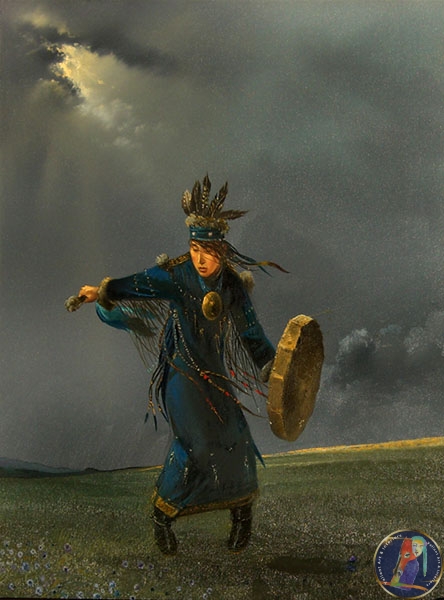
“Buu” is a masterclass in Photorealism and Figurative Realism, characteristic of Khurelbaatar Choindon’s technical discipline honed at the Repin Academy of Fine Art. The painting serves as a profound psychological portrait, capturing a moment of stillness that bridges the gap between traditional Mongolian identity and the meticulous precision of 19th-century Russian academic painting.
Key Elements and Composition
Subject and Expression: The piece focuses on a central figure, rendered with such anatomical precision that the texture of the skin, the moisture in the eyes, and the subtle tension in the facial muscles are clearly visible. Choindon utilizes his expertise in the figurative style to convey a sense of deep interiority—a hallmark of his portraiture.
Lighting and Texture: The use of light is dramatic yet naturalistic, suggesting a single source that carves the subject out of the background. The artist’s ability to manipulate oil paint is evident in the rendering of fabrics and surfaces, where the viewer can almost feel the weight and grain of the materials depicted.
Color Palette: Typical of Choindon’s work, the palette is grounded in earthy, organic tones. Rich ochres, deep umbers, and soft skin tones dominate the canvas, reflecting his strong association with Nature and Landscape aesthetics, even within a portrait context.
Atmosphere: Despite its modest size (50.5 x 40.5 cm), the painting possesses a monumental quality. There is a “quietude” to the work; it avoids the frantic energy of contemporary abstraction in favor of a timeless, steady gaze.
Artistic Context
Created in 2006, while Choindon was serving as the Vice Chairman of the Union of Mongolian Artists (UMA), “Buu” represents the pinnacle of the Mongolian Realist movement. It reflects a synthesis of his educational roots:
The Ulaanbaatar Foundation: A deep cultural connection to Mongolian heritage and subjects.
The St. Petersburg Influence: The rigorous, classical technique of the Repin Academy, visible in the perfect proportions and sophisticated layering of oil glazes.
In this work, Choindon does not merely document a likeness; he captures a specific cultural “weight,” documenting the dignity of his subject through a lens of uncompromising realism.