
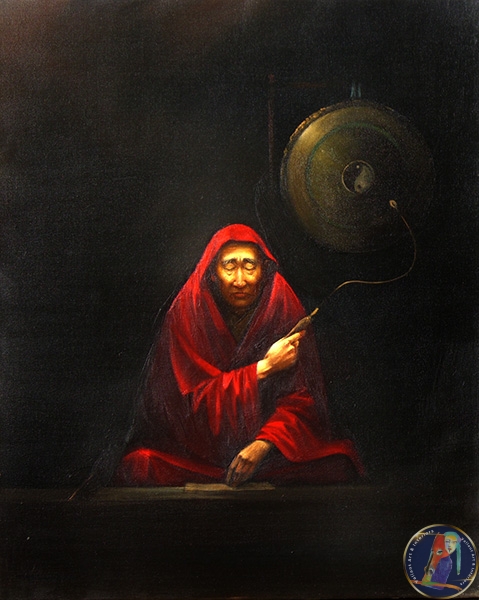
In this 2006 oil on canvas work, Khurelbaatar Choindon utilizes the rigorous technical training he received at the Repin Academy of Fine Art to present a profound study of spiritual devotion and aged character. Measuring 40.5 x 50.5 cm, the painting is an intimate portrayal that leans heavily into Photorealism and Figurative Realism, capturing a moment of quietude that feels both culturally specific to Mongolia and universally human.
Composition and Subject Matter
The painting features a close-up, bust-length portrait of an elderly Buddhist lama. The subject is positioned slightly off-center, creating a natural, candid feel that eschews the stiffness of traditional formal portraiture. The lama is draped in the traditional deep crimson and saffron robes, the textures of which are rendered with such precision that the weight and weave of the wool are almost palpable.
Mastery of Photorealism
Choindon’s mastery is most evident in the rendering of the lama’s face. Every wrinkle, liver spot, and crease is treated with clinical accuracy yet imbued with immense dignity. The skin possesses a weathered, parchment-like quality—a testament to a life lived in the high-altitude climate of Mongolia.
The lighting is soft and directional, casting subtle shadows that define the skeletal structure of the face. This light highlights the “crow’s feet” around the eyes and the slight recession of the hairline, emphasizing the passage of time.
Color Palette and Mood
Dominant Tones: The palette is dominated by earthy, warm tones—burnt siennas, deep reds, and golden ochres. These colors reflect the monastic attire and create a sense of warmth and sanctuary.
The Gaze: The lama’s eyes are the focal point. Choindon captures a look of profound “internalized” sight; the eyes are clear and wet, suggesting a lifetime of meditation and wisdom. There is a gentleness in the expression that balances the harsh reality of the physical aging process.
Atmosphere: The background is typically understated or out of focus, a technique that draws the viewer’s entire focus onto the subject’s humanity. It evokes a sense of stillness and silence, as if the viewer is sharing a private, meditative breath with the subject.
Artistic Significance
Lama serves as a bridge between the Russian Academic tradition (marked by anatomical perfection and structural integrity) and the Mongolian soul. By applying a highly disciplined realist style to a figure of Mongolian spiritual life, Choindon elevates the subject from a mere “type” to a specific, breathing individual. The work stands as a cornerstone of contemporary Mongolian realism, showcasing the artist’s ability to find the extraordinary within the ordinary features of a human face.