
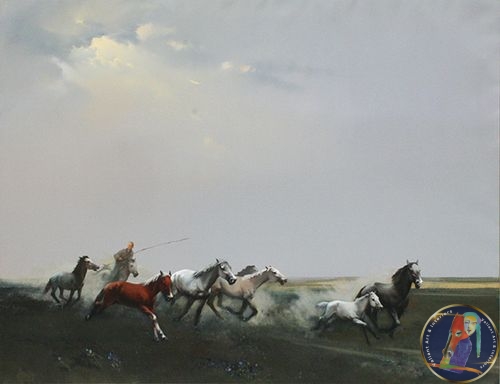
Running After Horse is a sweeping masterpiece by the Mongolian painter Khurelbaatar Choindon. Rendered in oil on a large-scale canvas ($140 \times 180\text{cm}$), the work is a definitive example of contemporary Mongolian photorealism, blending technical Russian Academic training with the raw, spiritual essence of the Central Asian steppe.
Visual Composition and Style
The painting captures a high-velocity moment in the lives of nomadic horsemen. True to Choindon’s association with Photorealism and Realism, every texture is rendered with meticulous precision:
The Subject: The central focus is a powerful, muscular horse in mid-gallop, its coat slick with sweat and dust. Following closely is a figure—a rider or a man on foot—whose posture conveys intense physical exertion and a deep, ancestral connection to the animal.
The Landscape: The background depicts the vast, undulating Mongolian steppe. Choindon uses a sophisticated atmospheric perspective to give the viewer a sense of the immense scale of the horizon, making the subjects appear both heroic and small against the infinite sky.
Motion and Energy: Despite the “still” nature of photorealism, the artist employs subtle motion blurs in the kicking dust and the flowing manes to simulate a sense of frantic speed.
Technique and Palette
Having studied at the prestigious Repin Academy of Fine Art in St. Petersburg, Choindon utilizes classical European techniques to elevate Mongolian subject matter:
Light and Shadow: The painting is bathed in the harsh, clear light typical of the “Land of the Eternal Blue Sky.” High contrasts define the musculature of the horse and the folds of traditional Mongolian attire.
Color Profile: The palette is dominated by earthy ochres, burnt sienna, and muted greens, punctuated by the brilliant, piercing blue of the Mongolian sky.
Textural Detail: The viewer can almost feel the grit of the kicked-up soil and the coarse hair of the horse’s hide, showcasing the “Figurative” mastery Choindon is known for.
Cultural Significance
Running After Horse is more than a nature study; it is a cultural document. It represents the “horse culture” that is central to Mongolian identity. Choindon, as the Vice Chairman of the Union of Mongolian Artists (UMA), uses this piece to bridge the gap between traditional nomadic life and the sophisticated world of international fine art.
The large dimensions of the canvas ensure that the viewer is not merely observing a scene, but is instead immersed in the kinetic energy and the silent, wind-swept power of the steppe.