2 Camels, One Lying

Khurelbaatar Choindon , 2006 , Oil On Canvas

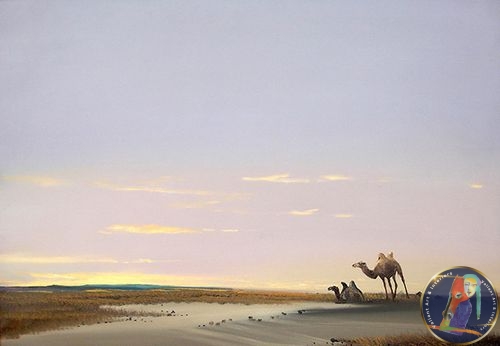
Rendered with the meticulous precision characteristic of Khurelbaatar Choindon’s Photorealist style, 2 Camels, One Lying is a masterclass in texture and atmospheric light. The painting captures a quiet, intimate moment between two Bactrian camels against the vast, minimalist backdrop of the Mongolian landscape. The composition is tight and focused, emphasizing the anatomical detail and the rugged dignity of the animals.


The Subjects

The focal point of the piece is the interaction between the two camels, their heavy, woolen coats rendered with such detail that the viewer can almost feel the coarseness of the fur.

  • The Lying Camel: Positioned in the foreground, this camel is settled into the earth. Its large, heavy humps drape slightly to the side, indicating a moment of deep rest. The artist uses subtle shifts in ochre, cream, and deep brown to define the folds of its skin and the density of its winter coat.

  • The Standing Camel: Towering slightly over its companion, the second camel stands in profile or a slight three-quarter turn. Its gaze is calm and steady, looking out toward the horizon. The light catches the tips of its fur, creating a soft “halo” effect that separates it from the sky.

Landscape and Light

True to the Realist and Landscape traditions, Choindon utilizes a naturalistic palette dominated by earth tones.

  • The Ground: The terrain is sparse, suggesting the arid, sandy soil of the Gobi or the Mongolian steppe. The artist uses fine brushwork to depict small pebbles and the slight shadows cast by the camels, grounding them firmly in the environment.

  • The Atmosphere: The background is likely a soft, hazy expanse—perhaps a pale sky that meets the horizon in a seamless transition. This lack of clutter draws the eye entirely to the “figurative” subjects, highlighting their isolation and resilience in the wild.


Artistic Execution

Reflecting his training at the Repin Academy of Fine Art, Choindon employs a sophisticated grasp of academic form. The painting is not merely a depiction of animals but a study of light hitting organic surfaces.

  • Texture: There is a tactile quality to the work; the contrast between the soft, fuzzy ears of the camels and the dry, hard earth beneath them is stark.

  • Mood: The piece evokes a sense of stillness and endurance. By choosing a 40 x 60 cm canvas, the artist creates an intimate “window” into the Mongolian wilderness, celebrating the iconic fauna of his homeland without the need for theatricality.

This work stands as a testament to Choindon’s role as a leading figure in the Union of Mongolian Artists (UMA), blending traditional Russian academic techniques with the soul of the Central Asian landscape.
  • Khurelbaatar Choindon
  • Nature, Realism
  • Oil On Canvas
  • KBR31/015
  • 40 x 60cm
  • Mongolian Art Gallery

Add Your Comment

Mongolian Art Gallery © 2025. All Rights Reserved
Privacy Policy / Terms of Use

Rendered with the meticulous precision characteristic of Khurelbaatar Choindon’s Photorealist style, 2 Camels, One Lying is a masterclass in texture and atmospheric light. The painting captures a quiet, intimate moment between two Bactrian camels against the vast, minimalist backdrop of the Mongolian landscape. The composition is tight and focused, emphasizing the anatomical detail and the rugged dignity of the animals.


The Subjects

The focal point of the piece is the interaction between the two camels, their heavy, woolen coats rendered with such detail that the viewer can almost feel the coarseness of the fur.

  • The Lying Camel: Positioned in the foreground, this camel is settled into the earth. Its large, heavy humps drape slightly to the side, indicating a moment of deep rest. The artist uses subtle shifts in ochre, cream, and deep brown to define the folds of its skin and the density of its winter coat.

  • The Standing Camel: Towering slightly over its companion, the second camel stands in profile or a slight three-quarter turn. Its gaze is calm and steady, looking out toward the horizon. The light catches the tips of its fur, creating a soft “halo” effect that separates it from the sky.

Landscape and Light

True to the Realist and Landscape traditions, Choindon utilizes a naturalistic palette dominated by earth tones.

  • The Ground: The terrain is sparse, suggesting the arid, sandy soil of the Gobi or the Mongolian steppe. The artist uses fine brushwork to depict small pebbles and the slight shadows cast by the camels, grounding them firmly in the environment.

  • The Atmosphere: The background is likely a soft, hazy expanse—perhaps a pale sky that meets the horizon in a seamless transition. This lack of clutter draws the eye entirely to the “figurative” subjects, highlighting their isolation and resilience in the wild.


Artistic Execution

Reflecting his training at the Repin Academy of Fine Art, Choindon employs a sophisticated grasp of academic form. The painting is not merely a depiction of animals but a study of light hitting organic surfaces.

  • Texture: There is a tactile quality to the work; the contrast between the soft, fuzzy ears of the camels and the dry, hard earth beneath them is stark.

  • Mood: The piece evokes a sense of stillness and endurance. By choosing a 40 x 60 cm canvas, the artist creates an intimate “window” into the Mongolian wilderness, celebrating the iconic fauna of his homeland without the need for theatricality.

This work stands as a testament to Choindon’s role as a leading figure in the Union of Mongolian Artists (UMA), blending traditional Russian academic techniques with the soul of the Central Asian landscape.