
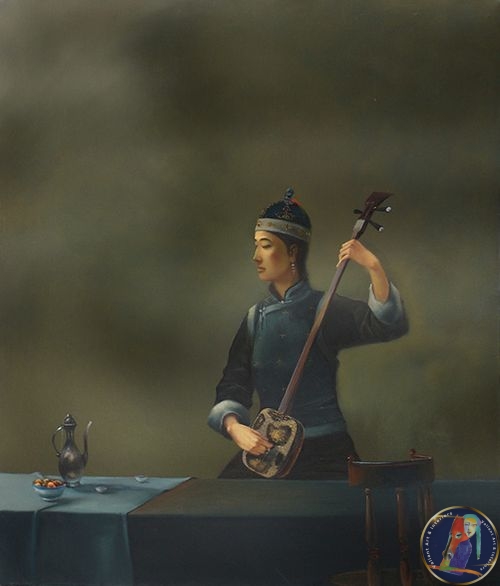
Melody is a masterful exploration of photorealism and cultural identity, capturing a moment of quiet, rhythmic grace. The painting features a female figure, likely Mongolian, engaged in a moment of musical or personal reflection. True to Choindon’s training at the Repin Academy of Fine Art, the work displays a sophisticated command of light, texture, and anatomical precision.
The Subject: The central figure is rendered with a soft, lifelike quality. Her expression is serene and contemplative, embodying the “melody” suggested by the title—not just as a sound, but as a state of being.
Color Palette: Choindon employs a harmonious blend of warm, earthy tones and deep, resonant shadows. The lighting is directional and evocative, reminiscent of the Chiaroscuro technique, which highlights the delicate contours of the subject’s face and hands while allowing the background to recede into a soft, atmospheric haze.
Texture and Detail: The artist’s background in Realism is evident in the meticulous rendering of fabric and skin. Whether the “melody” is produced by a traditional Mongolian instrument or is a metaphorical representation of the subject’s grace, the artist uses fine brushwork to suggest the tactile quality of silk, the warmth of human skin, and the stillness of the air surrounding the figure.
Artistic Context
Painted in 2006, this work represents the maturity of Choindon’s style after years of international exhibition and academic rigor. By blending the strict technical discipline of Russian Academicism (from his time in St. Petersburg) with the soulful, nomadic heritage of Mongolia, Choindon creates a piece that feels both contemporary and timeless.
The painting does not merely document a scene; it captures the “nature” of the soul. It stands as a testament to Choindon’s role as a leading figure in the Union of Mongolian Artists (UMA), bridging the gap between traditional figurative art and modern photorealistic sensibilities.
About the Artist
Khurelbaatar Choindon (b. 1959) is a preeminent Mongolian painter known for his ability to infuse technical perfection with deep emotional resonance. Educated in Ulaanbaatar and later at the prestigious Repin Academy in Russia, his work has been celebrated globally—from the Fukuoka Art Museum in Japan to galleries in Washington, Amsterdam, and Prague. Since 2001, his leadership as the Vice Chairman of the UMA has been pivotal in shaping the direction of Mongolian contemporary realism.