
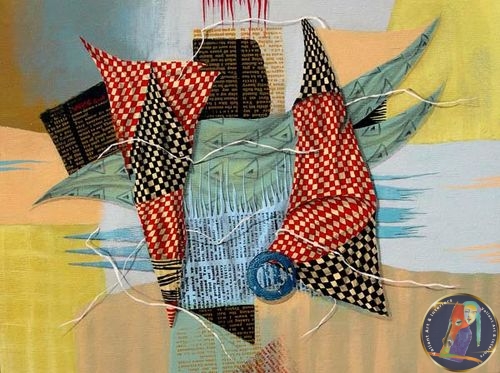
The Wind is a compelling acrylic on canvas work by Armenian artist Vahagn Harutyunyan. Measuring 37 x 50 cm, this piece serves as a bridge between Harutyunyan’s foundations in realism and his evocative explorations of surrealism and nature.
Visual Composition and Style
In The Wind, Harutyunyan captures the invisible force of nature through tangible, fluid movement. While the artist is well-versed in Realism, this piece leans heavily into Surrealism and Nature-inspired Abstraction.
Movement: The brushwork is rhythmic and directional, simulating the kinetic energy of a gust. Unlike a static still life, the composition feels as though it is in a constant state of flux.
Color Palette: Utilizing the versatile medium of acrylics, the artist likely employs a range of organic tones—deep earth pigments contrasted with airy, ethereal highlights—to illustrate the interaction between the atmosphere and the physical world.
Atmosphere: There is a signature Armenian sensibility in the light; Harutyunyan’s academic background at the Yerevan State Academy of Fine Arts is evident in the sophisticated layering and the structural integrity of the “invisible” subject.
Interpretive Context
Created in 2006, this painting belongs to a prolific period in Harutyunyan’s career, following several international exhibitions in Marseille, Barcelona, and Carmel.
The painting does not merely depict “wind” as a weather phenomenon but treats it as a psychological presence. By blending Still Life techniques with Abstract motion, Harutyunyan freezes a fleeting moment in time. The 37 x 50 cm dimensions offer an intimate viewing experience, drawing the spectator into a localized whirlwind that feels both powerful and delicately contained.
About the Artist: Vahagn Harutyunyan
Born in Yerevan in 1973, Harutyunyan is a product of the rigorous Armenian formalist tradition. His work is characterized by:
Diverse Range: Mastering everything from the rigid structures of Still Life to the fluid boundaries of Surrealism.
Academic Excellence: His decade-long journey through the Panos Terlemezyan College and the State Academy of Fine Arts provided him with the technical prowess to render complex natural forces with precision.
International Presence: His transition from local exhibitions dedicated to the memory of Nagorno-Karabakh victims to high-profile galleries in California and France highlights his evolution into a globally recognized voice in contemporary Armenian art.