
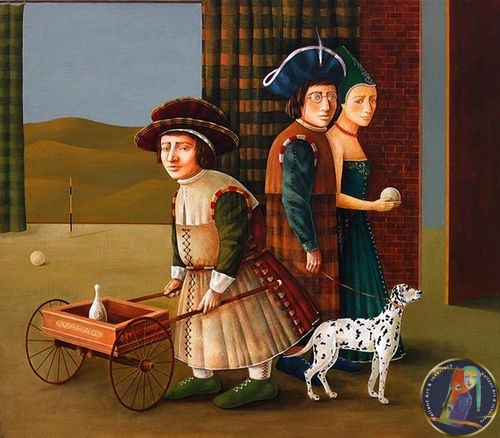
The Redundant Mace

Vahagn Harutyunyan , 2004 , Acrylic On Canvas

The Redundant Mace is a compelling synthesis of Harutyunyan’s diverse stylistic influences, blending the meticulous precision of Still Life and Realism with the unsettling logic of Surrealism. Set against a backdrop of muted, atmospheric tones, the painting centers on a singular, archaic weapon—a mace—that has been stripped of its martial utility and reimagined as a relic of obsolescence.

Composition and Subject Matter

The composition is dominated by the titular mace, rendered with a tactile realism that highlights the artist’s mastery of texture. The metallic head of the weapon, traditionally designed for impact, is depicted with oxidized surfaces and subtle glints of light, suggesting a history of both use and subsequent neglect.

However, the “redundancy” mentioned in the title is conveyed through surrealist interventions:

  • Juxtaposition: The mace is placed in a domestic or natural setting that contradicts its violent nature, perhaps resting atop an intricately draped cloth or suspended in a void-like space that renders it harmless.

  • Symbolic Decay: Elements of nature—typical of Harutyunyan’s interest in the natural world—may be seen encroaching upon the object. Vines or subtle floral motifs might twine around the handle, suggesting that time and the organic world have reclaimed what was once a tool of destruction.

  • Abstract Geometry: The background likely features Harutyunyan’s signature leanings toward Abstract forms, using blurred horizons or geometric partitions to isolate the object and elevate it from a mere physical tool to a psychological symbol.

Color Palette and Light

The palette is sophisticated and restrained, leaning into earthy umbers, deep ochres, and cool grays. This choice of color emphasizes the “weight” of the object while evoking a sense of somber nostalgia. Light is used strategically to create high contrast (chiaroscuro), pulling the mace out of the shadows to force the viewer to confront its intricate detail and its current state of uselessness.

  • Vahagn Harutyunyan
  • Sculpture, Still Life
  • Acrylic On Canvas
  • VAH/014
  • 70 x 80 cm
  • Mongolian Art Gallery

Add Your Comment

Mongolian Art Gallery © 2025. All Rights Reserved
Privacy Policy / Terms of Use

The Redundant Mace is a compelling synthesis of Harutyunyan’s diverse stylistic influences, blending the meticulous precision of Still Life and Realism with the unsettling logic of Surrealism. Set against a backdrop of muted, atmospheric tones, the painting centers on a singular, archaic weapon—a mace—that has been stripped of its martial utility and reimagined as a relic of obsolescence.

Composition and Subject Matter

The composition is dominated by the titular mace, rendered with a tactile realism that highlights the artist’s mastery of texture. The metallic head of the weapon, traditionally designed for impact, is depicted with oxidized surfaces and subtle glints of light, suggesting a history of both use and subsequent neglect.

However, the “redundancy” mentioned in the title is conveyed through surrealist interventions:

  • Juxtaposition: The mace is placed in a domestic or natural setting that contradicts its violent nature, perhaps resting atop an intricately draped cloth or suspended in a void-like space that renders it harmless.

  • Symbolic Decay: Elements of nature—typical of Harutyunyan’s interest in the natural world—may be seen encroaching upon the object. Vines or subtle floral motifs might twine around the handle, suggesting that time and the organic world have reclaimed what was once a tool of destruction.

  • Abstract Geometry: The background likely features Harutyunyan’s signature leanings toward Abstract forms, using blurred horizons or geometric partitions to isolate the object and elevate it from a mere physical tool to a psychological symbol.

Color Palette and Light

The palette is sophisticated and restrained, leaning into earthy umbers, deep ochres, and cool grays. This choice of color emphasizes the “weight” of the object while evoking a sense of somber nostalgia. Light is used strategically to create high contrast (chiaroscuro), pulling the mace out of the shadows to force the viewer to confront its intricate detail and its current state of uselessness.