
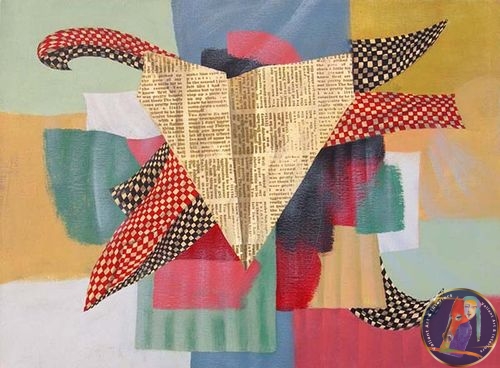
The painting features a central subject that is both mundane and symbolic: a folded paper airplane. Harutyunyan utilizes his mastery of Realism to render the texture of the paper—its sharp creases, the slight transparency of the material, and the way light interacts with its geometric folds.
However, the work leans heavily into Surrealism through its spatial arrangement. The airplane is often depicted in a suspended state, defying gravity within a background that oscillates between a minimalist Still Life setting and a vast, Abstract expanse. This creates a sense of profound stillness and isolation, a hallmark of Harutyunyan’s style.
Color Palette and Texture
Tonalities: The artist typically employs a sophisticated palette of muted earth tones, soft greys, and translucent whites. These colors give the paper a skeletal, almost fragile quality.
Atmosphere: The background is often characterized by layered, atmospheric brushwork that suggests a hazy sky or a weathered wall, blurring the lines between nature and an interior space.
Detailing: Precise shadows are used to anchor the “floating” object, providing a three-dimensional depth that contrasts with the ethereal nature of the subject matter.
Themes and Symbolism
In the context of Harutyunyan’s background—having lived through the post-Soviet transition in Yerevan and the Nagorno-Karabakh conflicts—the paper airplane acts as a potent metaphor:
Fragility vs. Flight: The delicate nature of the medium (paper) represents human vulnerability, while the form (an airplane) represents the enduring desire for escape, travel, and freedom.
Childhood and Memory: Given Harutyunyan’s early start at the Shahumian Art Centre, the subject evokes a nostalgic, universal childhood innocence, contrasted against the technical maturity of a seasoned academic painter.
The Interruption of Space: By placing a simple, man-made object within a surreal or naturalistic void, the artist explores the relationship between human thought and the infinite.