
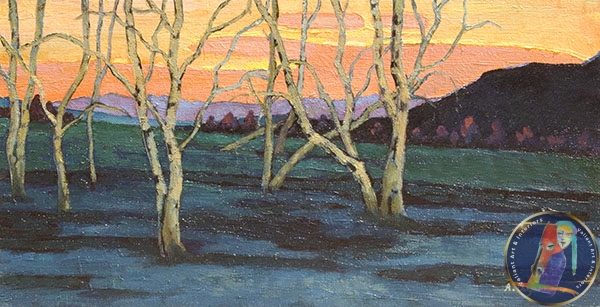
Sudalvar 1, executed in 2008 by Uuganbayar Amgalanbayar, is a striking example of the artist’s early focus on realism and his profound connection to the Mongolian landscape. Measuring 27 x 62 cm, the work utilizes a panoramic horizontal format, an intentional choice that emphasizes the vast, expansive nature of the steppe. Rendered in oil on canvas, the piece captures a delicate balance between fine detail and the sweeping atmospheric quality characteristic of the Bayankhongor region.
Composition and Imagery The composition is dominated by the horizontal lines of the terrain, drawing the viewer’s eye across the canvas to convey the characteristic “infinite” horizon of the Mongolian countryside. Amgalanbayar utilizes a grounded, earthy palette to anchor the foreground, gradually shifting into cooler, lighter tones to depict the distance. His approach to light and shadow suggests a specific time of day—likely the soft, diffused light of early morning or late afternoon—which enhances the three-dimensional depth of the landscape elements.
Technical Execution True to the artist’s dedication to realism, the brushwork is disciplined and precise. While the larger landforms are rendered with confident, broad strokes, the finer details of the flora and soil texture exhibit a controlled, meticulous hand. The layering of oil paint creates a rich, tactile surface that imbues the work with a sense of permanence and gravity. There is a palpable stillness in Sudalvar 1; by stripping away excessive artifice, Amgalanbayar forces the observer to confront the raw, unadorned beauty of the environment.
Thematic Significance Sudalvar 1 functions as more than a mere depiction of scenery; it is a contemplative study of space. The work reflects the artist’s upbringing in Bayanbulag, demonstrating an intimate knowledge of how light interacts with the steppe. In this 2008 piece, Amgalanbayar begins to establish the visual language—marked by a quiet dignity and a commitment to representational accuracy—that would eventually define his more mature portrait and nature studies. As an early professional work, it stands as a testament to his ability to transform the specific geographical character of his homeland into a universal aesthetic experience.