
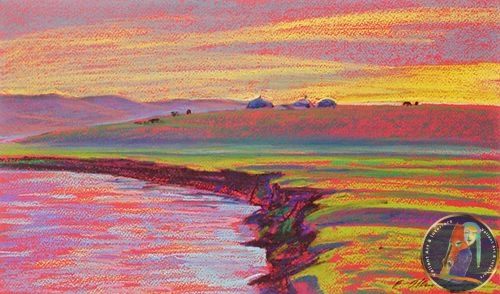
Nature 17

Tumurbaatar Badarch , 2006 , Pastel On Paper

Nature 17 is a contemplative exploration of the Mongolian wilderness, captured through the soft, tactile medium of pastel. Given Badarch’s background in Russian academic training and his roots in Ulaanbaatar, the piece reflects a sophisticated blend of European Realism and a deep, spiritual connection to the Central Asian landscape.

Composition and Atmosphere

The painting utilizes a horizontal orientation that emphasizes the vastness of the natural world, even within its modest 22 x 30 cm dimensions. The composition likely follows a classical realist structure, where the viewer’s eye is led from a detailed foreground—perhaps featuring the rugged textures of steppe grass or weathered stone—toward a hazy, atmospheric distance.

Color Palette and Texture

  • The Medium: The use of pastel allows Badarch to create soft, velvet-like transitions in the sky and earth. Unlike oil, pastel retains a matte, luminous quality that mimics the dry, clear light often found in high-altitude Mongolian environments.

  • The Tones: Expect a palette dominated by “earth logic”—ochres, burnt sienna, and muted golds reflecting the dormant flora, contrasted against the cool, receding blues or pale violets of distant mountain ranges.

  • The Technique: Subtle smudging techniques are likely used to depict the soft roll of hills, while sharper, linear strokes of the pastel stick define the resilient, scrubby vegetation characteristic of the region.

Thematic Essence

True to the “Oron Zai” (Space) art association’s philosophy—of which Badarch is a member—the painting likely focuses on the relationship between physical space and emotional stillness. There is a notable absence of human figures or man-made structures, focusing instead on “Nature” as a pure, autonomous subject. The work conveys a sense of timelessness, capturing a specific moment of light in 2006 that feels as though it could have existed centuries prior.


About the Artist: Tumurbaatar Badarch

Badarch is a significant figure in contemporary Mongolian realism. His education at the Mukhin Institute in St. Petersburg provided him with a rigorous technical foundation, which he adapted to express the unique light and topography of his homeland. His frequent participation in international exhibitions—from Italy to South Korea—highlights his role as a cultural ambassador, translating the specific beauty of the Mongolian landscape into a universal visual language.
  • Tumurbaatar Badarch
  • Expressionist, Nature
  • Pastel On Paper
  • TUM67/057
  • 22 x 30cm
  • Mongolian Art Gallery

Add Your Comment

Mongolian Art Gallery © 2025. All Rights Reserved
Privacy Policy / Terms of Use

Nature 17 is a contemplative exploration of the Mongolian wilderness, captured through the soft, tactile medium of pastel. Given Badarch’s background in Russian academic training and his roots in Ulaanbaatar, the piece reflects a sophisticated blend of European Realism and a deep, spiritual connection to the Central Asian landscape.

Composition and Atmosphere

The painting utilizes a horizontal orientation that emphasizes the vastness of the natural world, even within its modest 22 x 30 cm dimensions. The composition likely follows a classical realist structure, where the viewer’s eye is led from a detailed foreground—perhaps featuring the rugged textures of steppe grass or weathered stone—toward a hazy, atmospheric distance.

Color Palette and Texture

  • The Medium: The use of pastel allows Badarch to create soft, velvet-like transitions in the sky and earth. Unlike oil, pastel retains a matte, luminous quality that mimics the dry, clear light often found in high-altitude Mongolian environments.

  • The Tones: Expect a palette dominated by “earth logic”—ochres, burnt sienna, and muted golds reflecting the dormant flora, contrasted against the cool, receding blues or pale violets of distant mountain ranges.

  • The Technique: Subtle smudging techniques are likely used to depict the soft roll of hills, while sharper, linear strokes of the pastel stick define the resilient, scrubby vegetation characteristic of the region.

Thematic Essence

True to the “Oron Zai” (Space) art association’s philosophy—of which Badarch is a member—the painting likely focuses on the relationship between physical space and emotional stillness. There is a notable absence of human figures or man-made structures, focusing instead on “Nature” as a pure, autonomous subject. The work conveys a sense of timelessness, capturing a specific moment of light in 2006 that feels as though it could have existed centuries prior.


About the Artist: Tumurbaatar Badarch

Badarch is a significant figure in contemporary Mongolian realism. His education at the Mukhin Institute in St. Petersburg provided him with a rigorous technical foundation, which he adapted to express the unique light and topography of his homeland. His frequent participation in international exhibitions—from Italy to South Korea—highlights his role as a cultural ambassador, translating the specific beauty of the Mongolian landscape into a universal visual language.