Nature 21

Tumurbaatar Badarch , 2006 , Pastel On Paper

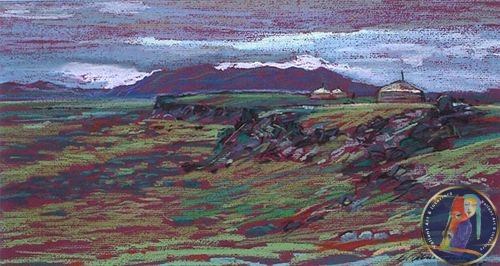
Nature 21 is a masterful exercise in Mongolian Realism, capturing the quiet, rugged essence of the Central Asian landscape. Executed in 2006, this piece showcases Badarch’s formal training from the Mukhin Institute in St. Petersburg, blending rigorous Russian academic technique with a deep, personal affinity for the Mongolian wilderness.

  • Atmosphere and Light: The use of pastel allows for a soft, atmospheric quality. The light is diffused, suggesting either the crisp clarity of a high-altitude morning or the muted tones of an overcast afternoon. There is a tangible sense of “Oron Zai” (space/environment), reflecting the artist’s long-standing association with the art movement of the same name.

  • Texture and Technique: Badarch leverages the grainy texture of the paper to mimic the natural elements—the coarse grass of the steppe, the weathered surfaces of distant peaks, and the ephemeral quality of the sky. The blending of pastels creates smooth gradients in the horizon, contrasting with sharper, deliberate strokes that define the foreground topography.

  • Color Palette: Typical of Badarch’s nature-focused works, the palette is likely grounded in earthy ochres, muted greens, and deep mineral blues. The colors are not exaggerated; they aim for a truthful representation of the Mongolian terrain, evoking a sense of stillness and timelessness.


Context and Significance

This work represents a mature period in Badarch’s career, created three years after his landmark solo exhibition Gerege (2003). While the dimensions are intimate (22 x 30 cm), the composition feels expansive, a hallmark of Mongolian landscape painting where the vastness of the land is the primary protagonist.

Through Nature 21, Badarch continues his lifelong exploration of the environment, a theme that has carried his work from Ulaanbaatar to international galleries in Italy, Korea, and France. It stands as a quiet testament to the enduring beauty of the natural world, captured by an artist who bridges the gap between traditional Mongolian aesthetics and classical European industrial art training.
  • Tumurbaatar Badarch
  • Nature
  • Oil On Canvas
  • TUM67/053
  • 22 x 30cm
  • Mongolian Art Gallery

Add Your Comment

Mongolian Art Gallery © 2025. All Rights Reserved
Privacy Policy / Terms of Use

Nature 21 is a masterful exercise in Mongolian Realism, capturing the quiet, rugged essence of the Central Asian landscape. Executed in 2006, this piece showcases Badarch’s formal training from the Mukhin Institute in St. Petersburg, blending rigorous Russian academic technique with a deep, personal affinity for the Mongolian wilderness.

  • Atmosphere and Light: The use of pastel allows for a soft, atmospheric quality. The light is diffused, suggesting either the crisp clarity of a high-altitude morning or the muted tones of an overcast afternoon. There is a tangible sense of “Oron Zai” (space/environment), reflecting the artist’s long-standing association with the art movement of the same name.

  • Texture and Technique: Badarch leverages the grainy texture of the paper to mimic the natural elements—the coarse grass of the steppe, the weathered surfaces of distant peaks, and the ephemeral quality of the sky. The blending of pastels creates smooth gradients in the horizon, contrasting with sharper, deliberate strokes that define the foreground topography.

  • Color Palette: Typical of Badarch’s nature-focused works, the palette is likely grounded in earthy ochres, muted greens, and deep mineral blues. The colors are not exaggerated; they aim for a truthful representation of the Mongolian terrain, evoking a sense of stillness and timelessness.


Context and Significance

This work represents a mature period in Badarch’s career, created three years after his landmark solo exhibition Gerege (2003). While the dimensions are intimate (22 x 30 cm), the composition feels expansive, a hallmark of Mongolian landscape painting where the vastness of the land is the primary protagonist.

Through Nature 21, Badarch continues his lifelong exploration of the environment, a theme that has carried his work from Ulaanbaatar to international galleries in Italy, Korea, and France. It stands as a quiet testament to the enduring beauty of the natural world, captured by an artist who bridges the gap between traditional Mongolian aesthetics and classical European industrial art training.