
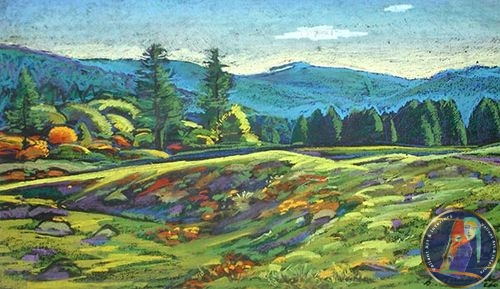
Nature 23 is a compelling testament to Tumurbaatar Badarch’s mastery of the pastel medium and his deep-rooted connection to the Mongolian landscape. Created in 2006, this 30 x 40 cm work reflects a sophisticated blend of his classical training in St. Petersburg and the atmospheric Realism that defines his career.
Visual Composition and Style
The painting is characterized by a soft, tactile quality inherent to pastel on paper. Badarch eschews harsh outlines in favor of layered pigments and blended transitions, creating a sense of depth and atmospheric perspective.
The Palette: Typical of Badarch’s nature-centric works, the palette is likely dominated by earthy ochres, deep forest greens, and the subtle, cool grays of the Mongolian sky. His use of light is not dramatic or theatrical, but rather steady and diffused, mimicking the vast, open lighting of the steppes.
The Texture: Through the “Nature” series, the artist often focuses on the physical grain of the land. The pastel is applied with varying pressure—heavily layered in the foreground to suggest the ruggedness of flora or stone, and feathered lightly toward the horizon to simulate distance.
Artistic Context and Influence
Badarch’s education at the Mukhin Institute of Industrial Art in Russia provided him with a rigorous foundation in formal composition, which he applies here to the organic unpredictability of nature.
Realism vs. Spirit: While the style is firmly rooted in Realism, there is an underlying poetic quality. Nature 23 does not just document a coordinate in Mongolia; it captures the “Oron Zai” (Space/Spirit) of the environment.
The “Nature” Series: As a member of the “Oron Zai” art association, Badarch’s work from this period often explores the silence and permanence of the natural world, contrasting the timeless landscape against the fleeting movements of light.