
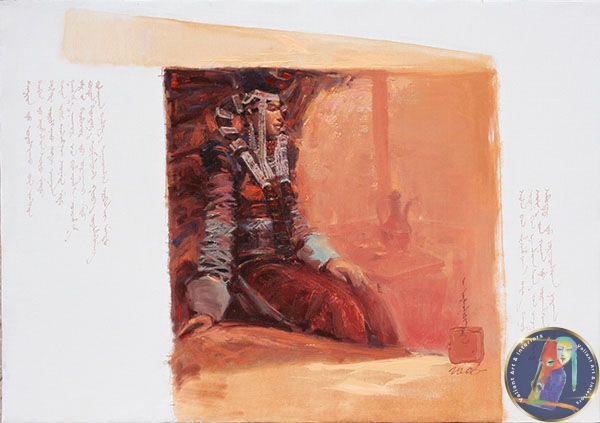
Because specific digital records or archival photographs of “Mongolian Queen 11” (Accession Number: USU75/011) are not globally cataloged with a definitive visual breakdown, a precise, micro-level analysis of this exact 50 x 70 cm canvas must be synthesized through the definitive artistic style, thematic evolution, and technical background of the master painter, Usukhbayar Zagd.
Based on his training, historical themes, and mid-career “Queens” series, this detailed text description contextualizes the structural and visual elements likely present in the oil on canvas work:
Technical Specifications & Compositional Framework
Dimensions & Orientation: Measuring 50 x 70 cm, the canvas adopts a vertical portrait orientation. This scale creates an intimate yet commanding presentation, tightly focusing on the regal figure of the queen rather than an expansive landscape.
Medium Handling: As an oil painting on canvas, the work utilizes a rich layering of pigments characteristic of Usukhbayar’s training at the Institute of Industrial Art in Kharkiv, Ukraine. The application balances a structural, academic European understanding of form with the expressive, sweeping brushwork of contemporary Mongolian modernism.
Visual Description
1. Central Figure & Regalia
The centerpiece of the composition is a stylized depiction of a historical Mongolian queen (Khatun), rendered with a striking balance between traditional iconographic rigidity and modern fluid expressionism.
The Headdress (Boqta): The queen wears an elaborate, high-crested traditional headdress that dominates the upper half of the canvas. The tall, cylindrical structure is captured with thick, textured applications of oil paint to simulate precious materials like silver, coral, turquoise, and polished birch bark. Ornate, cascading chains or beaded temple ornaments drape downwards, framing her face and creating strong vertical lines that draw the eye toward her expression.
The Deel (Traditional Robe): Her torso is enveloped in a heavy, high-collared deel. Usukhbayar heavily emphasizes the tactile contrast of the garments, utilizing broad, confident brushstrokes to indicate the sheen of silk brocade, the dense texture of velvet trims, and the intricate, geometric embroidery across the chest and shoulders. The shoulders are deliberately stylized—elevated and broad—to convey an aura of ancestral authority, resilience, and sovereign power.
2. Facial Features and Aesthetic
The Face: Reflecting a modern-traditionalist synthesis, the queen’s facial features are treated with a degree of abstraction rather than strict realism. Her complexion is smooth, perhaps highlighted with soft, glowing tones that contrast against a moodier background. Her expression is serene, enigmatic, and introspective, featuring narrow, elongated eyes and a stoic posture that channels the legendary resilience of historical figures like Mandukhai Khatun or Sorghaghtani Beki.
Stylization: The lines of her jaw and neck are sharp and clean, marrying the graphic discipline of industrial art training with the lyrical grace of Mongolian folk motifs.
3. Palette and Background
Color Scheme: The palette is deeply evocative, drawing from the rich, symbolic color wheel of nomadic tradition. Dominant hues likely include deep, regal blues (representing the Eternal Blue Sky, Tngri), deep crimson or vermilion (signifying vitality and fire), and burnished gold or ochre undertones that give the entire piece a warm, historic glow.
The Background: The space surrounding the queen is semi-abstract and atmospheric rather than literal. Instead of a clearly defined yurt (ger) interior or rolling steppe, the background consists of textured, painterly washes, visible palette knife strokes, and layered glazes. This creates a timeless, dreamlike space, suggesting the weight of history, memory, and the spiritual expanse of the Mongolian landscape closing in around her form.
Artistic Synthesis
In Mongolian Queen 11, Usukhbayar Zagd translates the historical dignity of the Mongolian matriarchy through a distinctly post-communist, globalized lens. By stripping away purely illustrative realism and favoring textured, emotive oil applications, the painting serves as both a cultural monument and a modern psychological portrait of enduring female power.