
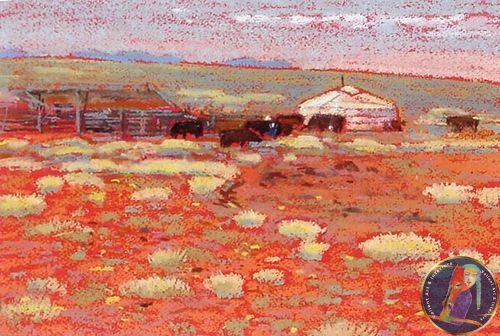
In Nature 6, Tumurbaatar Badarch utilizes the soft, tactile quality of pastels to capture a serene fragment of the Mongolian landscape. Adhering to his roots in Realism, the artist avoids grand, sweeping vistas in favor of an intimate, focused look at the textures of the earth.
Composition and Light: The piece is characterized by a sophisticated interplay of light and shadow. The light source appears low, as if during the “golden hour,” casting long, soft shadows that give three-dimensional volume to the undulating terrain.
Color Palette: The palette is earthy and grounded, dominated by ochres, muted greens, and burnt umbers. The use of pastel allows for a seamless blending of tones, creating a hazy, atmospheric quality that suggests the crisp, dry air of the Mongolian steppe.
Texture: Subtle strokes of the pastel stick are visible in the foreground, mimicking the appearance of hardy shrubbery and weathered soil. As the eye moves toward the background, the detail softens into a more lyrical abstraction of form, emphasizing the vastness of the natural world even within a small 30 x 40 cm frame.
Artistic Context
Created in 2006, this work represents the maturity of Badarch’s style following his rigorous academic training at the College of Fine Art in Ulaanbaatar and the Mukhin Institute in St. Petersburg. The painting reflects a synthesis of Russian formalist discipline and a deeply personal, nomadic appreciation for the environment.
By focusing on “Nature” as a recurring theme, Badarch strips away the noise of modern industrial life—a skill likely honed during his time with the “Oron Zai” (Space) art association. Nature 6 serves as a meditative study on permanence and the quiet beauty of the unpeopled landscape.