

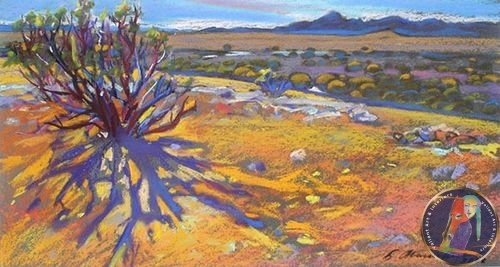
Nature 7 is an intimate yet expansive exploration of the Mongolian wilderness, rendered with the soft, tactile precision characteristic of high-quality pastel work. Despite its relatively small scale (22 x 30 cm), the piece captures a sense of vast atmospheric depth.
Composition and Perspective: The painting utilizes a classic realist landscape structure. The foreground is anchored by textured earth and low-lying vegetation, leading the eye toward a mid-ground defined by rolling hills or gentle topographical shifts. The horizon line is placed to give prominence to the land, emphasizing the grounded, enduring nature of the Mongolian steppe.
Color Palette: Badarch employs a sophisticated palette of earthy tones—ochres, muted sienna, and sage greens—blended seamlessly to represent the natural transition of light across the terrain. The use of pastels allows for a soft, velvety finish, mimicking the way light filters through a clear, high-altitude atmosphere.
Technique: Reflecting his training at the Mukhin Institute in St. Petersburg, Badarch demonstrates a masterful command of Realism. The strokes are deliberate yet blended, creating a “soft focus” effect that avoids the harsh edges of oil paint. There is a palpable sense of stillness in the work, a hallmark of his “Oron Zai” (Space) association influence, where the void and the silence of nature are as important as the physical subjects.
Mood and Atmosphere: The painting evokes a contemplative, serene mood. It does not depict a specific “event” in nature but rather the timeless essence of the landscape. The interplay of light and shadow suggests either the golden hour of late afternoon or the crisp clarity of early morning, highlighting the subtle undulations of the earth.
Artistic Context
Created in 2006, Nature 7 represents a mature period in Badarch’s career. Having been educated in both Ulaanbaatar and Russia, his style bridges the gap between Russian Academic Realism and a uniquely Mongolian sensibility regarding space and nomadic heritage.
