

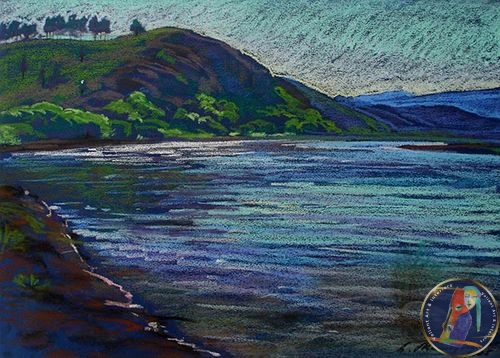
Nature 30 is a compelling testament to Tumurbaatar Badarch’s mastery of the pastel medium and his deep-seated connection to the Mongolian landscape. Created in 2006, this work reflects the refined realism Badarch developed through his rigorous academic training in both Ulaanbaatar and St. Petersburg.
Visual Composition and Style
The painting is an intimate yet expansive study of the natural world, rendered on a 30 x 40cm paper format. Badarch utilizes the soft, blendable qualities of pastel to capture the atmospheric nuances of the Mongolian wilderness.
Atmospheric Realism: Unlike the starkness often associated with nomadic landscapes, “Nature 30” likely emphasizes the interplay of light and texture. The artist’s background in industrial art and classical realism allows him to treat the elements of nature—rock, grass, or sky—with a tactile sensitivity.
Color Palette: Given Badarch’s typical style, the palette likely favors earthy, organic tones—ochres, deep greens, and muted blues—that evoke the specific light of the Central Asian steppe or the rugged terrain of northern Mongolia.
Technique: The use of pastel on paper allows for a “velvety” finish. Badarch likely employed layering techniques to create depth, using sharp strokes for the structural details of the landscape and softer, smudged strokes for the horizon and sky.
Context and Artistic Intent
Produced during a mature phase of his career, “Nature 30” represents the intersection of Mongolian heritage and European technical precision.
The “Oron Zai” Influence: As a member of the “Oron Zai” (Space) art association, Badarch’s work in this period often explored the concept of space—not just as a physical distance, but as a spiritual or emotional presence within the landscape.
Cultural Significance: The painting serves as a quiet observation of the environment. It moves away from the grand narrative paintings of the Soviet era toward a more personal, contemplative “Realism” that celebrates the inherent beauty of the land itself.
