
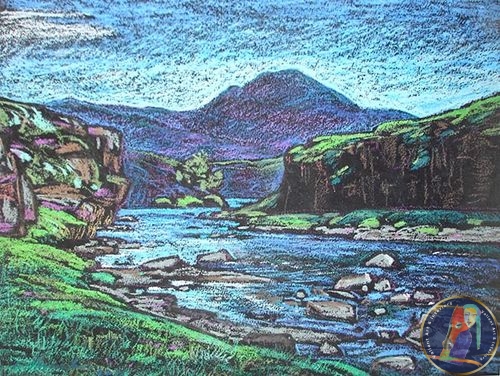
Nature 31 is a masterful exploration of the Mongolian landscape, rendered with the soft, tactile precision characteristic of Tumurbaatar Badarch’s realist style. Created in 2006, this work captures a serene, atmospheric moment in time, utilizing the powdery texture of pastels to bridge the gap between photographic realism and emotive expression.
Composition and Subject Matter
The painting focuses on a tranquil expanse of nature, likely inspired by the vast, undulating terrains of the artist’s homeland. Badarch employs a balanced composition that draws the viewer’s eye across a gentle gradient of light and shadow. As a hallmark of the Realism movement, the work avoids romanticized exaggeration, opting instead for a faithful depiction of the earth’s natural contours and the subtle interplay of flora.
Color Palette and Light
The color story of Nature 31 is dominated by earthy, organic tones. Badarch utilizes:
Muted Ochres and Umbers: Defining the dried grasses or rugged soil of the steppe.
Soft Greens and Siennas: Suggesting transitions in the season or the presence of hardy vegetation.
Atmospheric Haze: The artist uses the blending capabilities of the pastel medium to create a sense of depth, where the distant background softens into hazy, ethereal hues.
The light in the piece feels diffused, as if filtered through a high-altitude Mongolian sky, casting soft shadows that give the landscape a three-dimensional, physical presence.
Technique and Style
Having been educated at both the College of Fine Art in Ulaanbaatar and the Mukhin Institute in St. Petersburg, Badarch’s technique reflects a sophisticated blend of Mongolian traditional sensibilities and rigorous Russian academic training.
Texture: The use of pastel on paper allows for a velvety surface quality. Badarch layers the pigment to create a rich density in the foreground while maintaining a feather-light touch in the sky and distant horizons.
Detail: Every stroke serves the purpose of realism—mimicking the way light hits a specific ridge or the way shadows pool in a valley—yet the overall effect remains peaceful and contemplative rather than clinical.
About the Artist: Tumurbaatar Badarch
Born in 1958 in Ulaanbaatar, Badarch is a prominent figure in Mongolian contemporary art. His work is frequently associated with the “Oron Zai” (Space) art association, a group known for pushing the boundaries of Mongolian visual language while remaining rooted in the country’s profound relationship with nature.
His extensive exhibition history—spanning Italy, Korea, France, and Hong Kong—underscores his role as a cultural ambassador, bringing the quiet majesty of the Mongolian landscape to a global audience. Nature 31 stands as a quintessential example of his ability to find the extraordinary within the stillness of the natural world.