
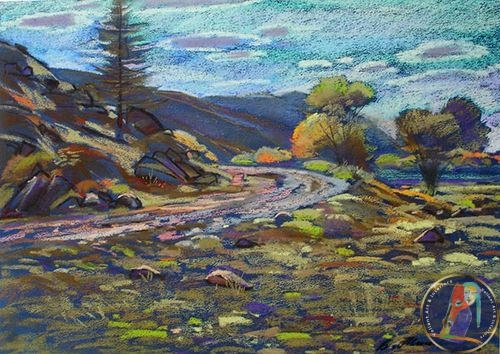
In Nature 49, Tumurbaatar Badarch captures a serene, intimate glimpse of the Mongolian wilderness, showcasing the delicate precision of his Realist style. The composition focuses on a rhythmic interplay between rugged geological textures and the soft, fleeting qualities of light.
Subject Matter: The painting features a detailed study of a rocky outcrop or a gentle hillside transition. Unlike the sprawling, epic vistas often associated with Mongolian landscapes, this piece draws the viewer into a closer, more contemplative view of the earth’s surface.
Color Palette: The artist utilizes a sophisticated range of earthy tones—ochres, burnt siennas, and muted umbers—to define the stony terrain. These are balanced by soft, atmospheric washes of cool greys and pale blues in the distance, creating a sense of vast space even within a confined frame.
Technique: Badarch’s mastery of the watercolor medium is evident in his control of transparency. He employs “wet-on-dry” techniques to create the sharp, craggy edges of the rocks and “wet-on-wet” gradients to suggest the hazy, moisture-laden air of the Mongolian highlands. The 30 x 40 cm scale allows for fine, calligraphic brushwork that highlights the sparse vegetation clinging to the crevices.
Artistic Context
Created in 2006, this work reflects the culmination of Badarch’s diverse training, blending the traditional foundations of the College of Fine Art in Ulaanbaatar with the rigorous technical discipline of the Mukhin Institute in St. Petersburg.
Nature 49 is not merely a topographical record; it is an exploration of the “Oron Zai” (Space) philosophy. By focusing on a specific fragment of nature, Badarch evokes the spiritual resonance of the landscape, emphasizing the quiet permanence of the land against the seasonal shifts of the Mongolian climate. The work stands as a testament to the artist’s role in the contemporary Mongolian Realist movement, bridging the gap between classical Russian academicism and a deep-seated nomadic appreciation for the natural world.