
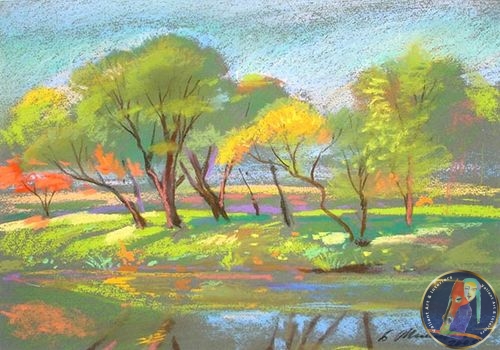
Nature 54

Tumurbaatar Badarch , 2006 , Pastel On Paper

In Nature 54, Tumurbaatar Badarch utilizes the soft, tactile qualities of pastel to capture the rugged serenity of the Mongolian landscape. The composition is a masterclass in Realism, focusing on the interplay between light and organic texture.

  • Foreground and Texture: The lower half of the 30 x 40 cm piece is likely dominated by the undulating terrain of the steppe or foothills. Given Badarch’s background and the “Nature” series style, expect a delicate layering of earth tones—ochres, muted greens, and sienna—blended with the precision characteristic of his St. Petersburg training.

  • Atmospheric Perspective: The use of pastel allows for a soft diffusion of light, creating a hazy, expansive feeling in the distance. The artist often captures the specific clarity of Mongolian air, where distant mountains appear in sharp yet pale silhouettes against a vast sky.

  • Color Palette: The palette is grounded in naturalism. Unlike the bold primaries of some Mongolian modernists, Badarch leans into the subtle gradations of the natural world, using the powdery medium to mimic the softness of wild grasses or the weathered surface of ancient rock formations.


Artistic Context & Style

Badarch’s work is a bridge between the Academic Realism he mastered at the Mukhin Institute in St. Petersburg and the deep, spiritual connection to the Mongolian environment.

  • Technical Mastery: His education in Russia provided him with a rigorous foundation in industrial and fine arts, which manifests in Nature 54 through balanced proportions and a sophisticated understanding of light-source direction.

  • The “Oron Zai” Influence: As a regular contributor to the “Oron Zai” (Space) art association, Badarch’s work often explores the concept of “space” not just as a physical location, but as a cultural and emotional vacuum filled by the grandeur of the wilderness.

  • Scale and Intimacy: At 30 x 40 cm, this is an intimate study. While many landscape paintings aim for the “sublime” through massive canvases, Badarch achieves a sense of monumental scale within a small frame, inviting the viewer to look closely at the rhythmic patterns of the earth.
  • Tumurbaatar Badarch
  • Nature, Realism
  • Pastel On Paper
  • TUM67/022
  • 30 x 40cm
  • Mongolian Art Gallery

Add Your Comment

Mongolian Art Gallery © 2025. All Rights Reserved
Privacy Policy / Terms of Use

In Nature 54, Tumurbaatar Badarch utilizes the soft, tactile qualities of pastel to capture the rugged serenity of the Mongolian landscape. The composition is a masterclass in Realism, focusing on the interplay between light and organic texture.

  • Foreground and Texture: The lower half of the 30 x 40 cm piece is likely dominated by the undulating terrain of the steppe or foothills. Given Badarch’s background and the “Nature” series style, expect a delicate layering of earth tones—ochres, muted greens, and sienna—blended with the precision characteristic of his St. Petersburg training.

  • Atmospheric Perspective: The use of pastel allows for a soft diffusion of light, creating a hazy, expansive feeling in the distance. The artist often captures the specific clarity of Mongolian air, where distant mountains appear in sharp yet pale silhouettes against a vast sky.

  • Color Palette: The palette is grounded in naturalism. Unlike the bold primaries of some Mongolian modernists, Badarch leans into the subtle gradations of the natural world, using the powdery medium to mimic the softness of wild grasses or the weathered surface of ancient rock formations.


Artistic Context & Style

Badarch’s work is a bridge between the Academic Realism he mastered at the Mukhin Institute in St. Petersburg and the deep, spiritual connection to the Mongolian environment.

  • Technical Mastery: His education in Russia provided him with a rigorous foundation in industrial and fine arts, which manifests in Nature 54 through balanced proportions and a sophisticated understanding of light-source direction.

  • The “Oron Zai” Influence: As a regular contributor to the “Oron Zai” (Space) art association, Badarch’s work often explores the concept of “space” not just as a physical location, but as a cultural and emotional vacuum filled by the grandeur of the wilderness.

  • Scale and Intimacy: At 30 x 40 cm, this is an intimate study. While many landscape paintings aim for the “sublime” through massive canvases, Badarch achieves a sense of monumental scale within a small frame, inviting the viewer to look closely at the rhythmic patterns of the earth.