
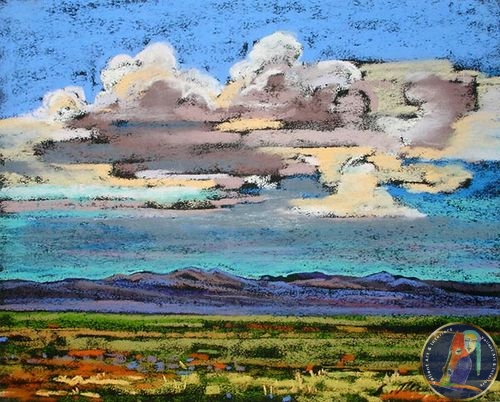
In Nature 48, Tumurbaatar Badarch utilizes the soft, blendable qualities of pastel to capture the atmospheric essence of the Mongolian wilderness. True to his roots in Realism, the painting focuses on the interplay of light and texture found in a rugged landscape.
Composition: The work likely features a balanced, horizontal perspective typical of his 30 x 40 cm series, emphasizing the vastness of the terrain. The foreground usually contains intricate details of flora or earth, leading the eye toward a softer, more ethereal background.
Color Palette: Given the artist’s focus on nature, the palette is dominated by earthy ochres, muted greens, and the soft blues or grays of the Mongolian sky. The use of pastel allows for seamless gradients, mimicking the way light filters through the high-altitude atmosphere.
Technique: Badarch’s Russian training at the Mukhin Institute is evident in the disciplined structure of the landscape. He avoids abstraction, instead using precise strokes to define the weight of stones or the fragility of steppe grass, contrasting sharp details with the “soft-focus” effect characteristic of the pastel medium.
About the Artist: Tumurbaatar Badarch
Born in 1958 in Ulaanbaatar, Badarch is a pivotal figure in Mongolian contemporary realism. His work is a bridge between traditional Mongolian appreciation for the land and the rigorous academic techniques of the St. Petersburg school of art.
Artistic Pedigree:
Mongolian Foundations: His early studies at the College of Fine Art in Ulaanbaatar (1978) grounded him in the local aesthetic and the importance of the “Gerege” (the title of his 2003 solo show), symbolizing authority and heritage.
Russian Influence: Graduating from the Mukhin Institute of Industrial Art in 1985 provided him with a sophisticated understanding of form, light, and industrial design principles, which he translated into his highly structured landscapes.