
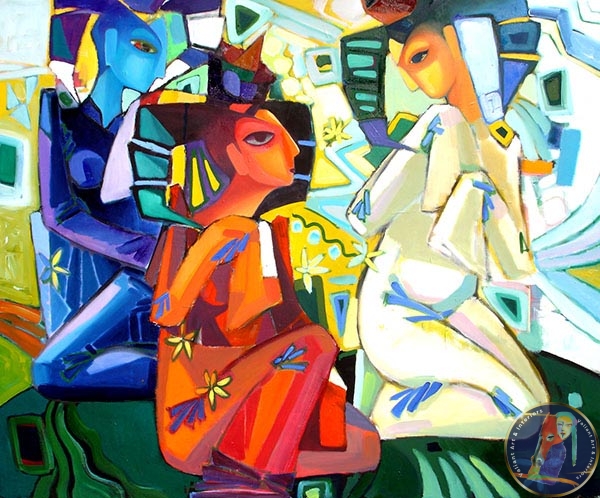
Winter Of Gobi is an evocative oil on canvas painting by the contemporary Mongolian artist Uranchimeg Sodnom (b. 1973, Ulaanbaatar). Measuring 90 x 110 cm (Accession Number: URN52/013), the piece reflects Sodnom’s formal training from the Fine Art University in Ulaanbaatar and her immersion in the rich cultural history of the Union of Mongolian Artists.
Influenced by expressionist and modern figurative styles, Sodnom captures the stark, beautiful, and demanding landscape of the Gobi Desert during the bitter winter months—a period when temperatures regularly plunge far below freezing.
Detailed Visual Description
Composition and Depth
The painting utilizes a sweeping horizontal composition that emphasizes the vast, unending scale of the Mongolian landscape. The perspective is expansive, positioning the viewer at a low-to-mid angle looking out across rolling terrain. Rather than relying on rigid, hard lines, the composition flows organically, mirroring the soft yet immense contours of the desert’s shifting dunes and rocky outcroppings now reshaped by heavy winter elements.
Color Palette and Light
The color choices intentionally contrast the traditional perception of a desert with the harsh realities of a Mongolian winter.
The Ground Elements: The canvas is dominated by a cool, layered palette of muted whites, soft blues, and icy grays representing the snowpack. Interspersed through these cool tones are patches of raw sienna, deep ochre, and earthy browns, showing where the wind has swept the snow away to reveal the freezing sand and sparse, dry desert vegetation beneath.
The Sky and Atmosphere: The sky hangs heavy over the landscape, painted in gradients of pale slate, soft lavender, and atmospheric blues. The light is diffused and non-directional, perfectly capturing the overcast, biting chill of a high-altitude winter day where the sun is muted by thick frost or impending snow flurries.
Textures and Brushwork
Sodnom uses the versatility of oil paint to create dense textural contrasts across the canvas:
The Foreground: Thick, expressive, and tactile brushstrokes (and subtle palette knife work) create a physical sense of frozen, uneven terrain. The impasto technique mimics the crusty, hardened layer of snow mixed with desert grit.
The Background: The brushwork softens substantially toward the horizon, blending the distant hills into the sky to create a powerful sense of atmospheric perspective and cold isolation.
Subject Matter & Mood
The painting centers on the quiet endurance of the Gobi environment. While reflecting figurative and expressionistic leanings, the subject is the desert itself—a space of dramatic seasonal shifts. The vast open spaces convey a deep, meditative silence. There is a profound tension between the stillness of the landscape and the implied harshness of the freezing winds, illustrating the nomadic spirit and rugged majesty of the Mongolian wilderness.