

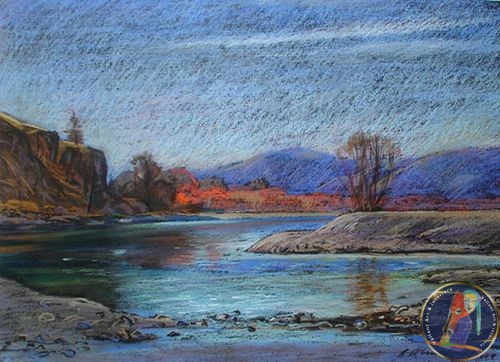
In Nature 33, Tumurbaatar Badarch leverages his mastery of the pastel medium to capture the quiet, rugged soul of the Mongolian landscape. Given Badarch’s background at the Mukhin Institute in St. Petersburg and his roots in Ulaanbaatar, the work reflects a sophisticated blend of Russian academic realism and a deep, spiritual connection to his homeland’s natural terrain.
Visual Composition and Style
The painting is a masterclass in Realism, focusing on the tactile textures of the earth. Because the piece is executed in pastel, the surface possesses a soft, velvet-like quality that contrasts beautifully with the often harsh subject matter of the Mongolian wilderness.
Atmosphere: There is an inherent stillness to the piece. Badarch eschews dramatic action in favor of a “moment in time,” capturing the specific quality of light as it hits the undulating surfaces of the ground.
Color Palette: Expect a sophisticated array of earthy tones—ochres, deep umbers, and muted siennas—punctuated by the subtle, cool grays of stone or the sparse, hardy greens of steppe vegetation. The use of pastel allows for seamless blending, creating soft gradients in the sky that suggest the vast, open air of the high plateau.
Texture: One of the most striking elements is the artist’s ability to render the “bone” of the land. Through delicate layering, he distinguishes between the crumbly texture of dry soil, the solid permanence of rock, and the ephemeral softness of low-lying clouds or mist.
Cultural and Academic Context
Badarch’s education in both Mongolia and Russia (St. Petersburg) is evident in the technical precision of Nature 33. The 30 x 40 cm scale offers an intimate window into a vast world; it is a small frame containing an expansive horizon.
As a member of the “Oron Zai” (Space) art association, Badarch’s work often explores the concept of space—not just as a physical distance, but as a philosophical presence. In this painting, the “Nature” depicted is likely not just a literal representation of a hill or a valley, but an exploration of the enduring, stoic character of the Mongolian environment that has remained unchanged for millennia.