

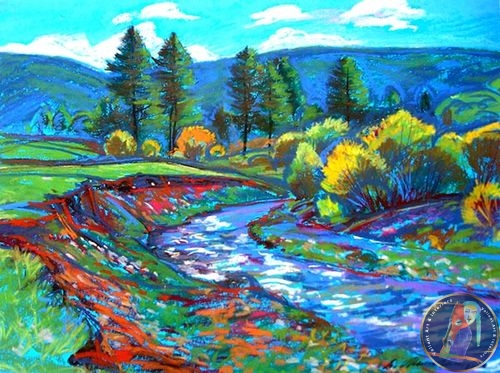
Nature 36 is a masterful exploration of the Mongolian wilderness, captured through the soft, tactile medium of pastel. Given Tumurbaatar Badarch’s background in Realism and his deep connection to his homeland, the painting presents a serene, atmospheric landscape that balances technical precision with emotional resonance.
Composition and Perspective: The work likely utilizes a classic landscape composition, drawing the viewer’s eye from a detailed foreground—perhaps featuring the rugged textures of the Mongolian steppe or a quiet riverbank—toward a soft, receding horizon. The 30 x 40 cm scale provides an intimate window into a vast space, making the expansive nature of the Mongolian countryside feel personal and immediate.
Color Palette and Lighting: As a pastel piece, the colors are characterized by their velvety matte finish. Badarch likely employs a palette of earthy ochres, muted greens, and cool cerulean blues. The light in the painting suggests a specific time of day—likely the “golden hour” or a hazy afternoon—where the sun casts long, soft shadows and illuminates the natural contours of the land without harsh contrasts.
Technique and Texture: Badarch’s training at the Mukhin Institute in St. Petersburg is evident in the sophisticated handling of light and form. The pastels are layered to create depth; fine lines might define the delicate blades of wild grass or the jagged edges of distant rocky outcrops, while broader, blended strokes suggest the weight of low-hanging clouds or the rolling movement of the hills. There is a palpable sense of stillness in the work, a hallmark of his nature-focused style.
Context and Significance
Created in 2006, Nature 36 represents a mature period in Badarch’s career. By this time, he had been a regular contributor to the Union of Mongolian Artists (UMA) for nearly three decades and had exhibited internationally from Italy to South Korea.
The painting is more than a literal representation of a location; it is a reflection of the “Oron Zai” (Space) philosophy often found in Mongolian art—a focus on the spiritual and physical relationship between the people and the eternal blue sky and vast earth. In this piece, Badarch translates the ruggedness of the Mongolian landscape into a poetic, softened reality, inviting the viewer to contemplate the quiet beauty of the natural world.
