Horse Composition 4

Undram Enkhbold , 2009 , Oil On Canvas

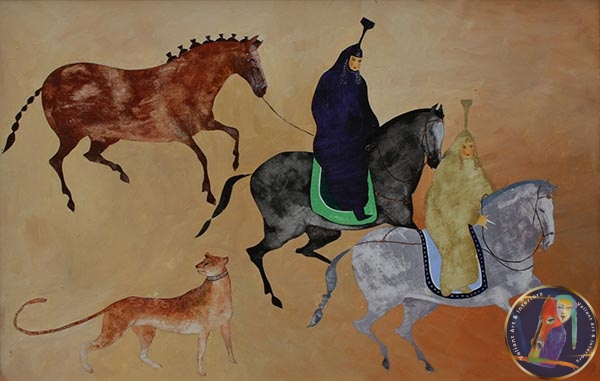
Horse Composition 4 (2009) is a compelling oil on canvas painting by the contemporary Mongolian artist Undram Enkhbold (born 1985, Ulaanbaatar). Measuring 40 by 60 centimeters, this moderately sized work is cataloged under the accession number UND/011. The artwork masterfully bridges traditional “Zurag” sensibilities (traditional Mongolian painting style) with modern abstraction, offering a powerful, fluid interpretation of Mongolia’s most sacred cultural symbol: the horse.

Visual Description

Subject Matter & Composition

The painting features a stylized, dynamic gathering of horses that seem to bleed into and emerge from one another, rather than being depicted as distinct, separated animals. The composition rejects strict linear perspective in favor of a compressed, layered arrangement.

The forms of the horses are heavily stylized. Enkhbold uses sweeping, calligraphic lines to define the arching necks, powerful chests, and flowing manes of the creatures. The anatomy is simplified into elegant, elongated geometric curves and sharp angles, capturing the raw energy, speed, and spirit of the wind-horse (Hiimori) rather than anatomical literalism. The overlapping shapes create a dense, rhythmic pattern across the canvas, evoking the sensation of a herd moving swiftly across the steppes.

Color Palette & Atmospheric Effects

The color palette is a sophisticated blend of earthy tones juxtaposed with modern, vibrant hues, reflecting the transition from nomadic traditions to contemporary life:

  • Dominant Tones: Deep ochres, burnt sienna, and warm, sandy beiges anchor the composition, paying homage to the natural landscape of the Mongolian landscape and the coat colors of native horses.

  • Accents: Interspersed throughout the earthy layers are intentional strokes of muted turquoise, deep charcoal black, and flashes of stark white.

  • Blending: The paint is applied with varied textures—ranging from smooth, thin glazes that allow underlying shapes to ghost through, to thicker, more expressive brushwork. The colors blend fluidly at the edges of the figures, making it difficult to see where one horse ends and the next begins, which enhances the dreamlike, continuous motion of the piece.

Style & Technique

As an exemplar of Modern Mongolian Art, Horse Composition 4 relies heavily on the expressiveness of line and the reduction of form. The influence of traditional Mongolian art is evident in the flattened spatial depth and the emphasis on the elegant contour lines of the animals.

However, Enkhbold updates this tradition using modern European modernist influences, such as Cubist flattening and Futurist movement. The background is largely non-representational, consisting of textured, atmospheric color fields that mirror the tones of the horses, creating a unified surface where the subjects and the space they occupy completely merge.

Summary of Visual Intent: Through Horse Composition 4, Undram Enkhbold transforms a literal herd of horses into a singular, pulsing organism of pure movement. The painting captures not just the physical form of the animal, but the enduring nomadic pulse and kinetic energy of modern Mongolia.
  • Undram Enkhbold
  • Ulaanbaatar, Mongolia
  • Modern/Contemporary, Mongolian Style
  • Oil on canvas
  • UND/011
  • 40 x 60 cm15" x 23"
  • Valiant Art & Interiors

Add Your Comment

Mongolian Art Gallery © 2025. All Rights Reserved
Privacy Policy / Terms of Use

Horse Composition 4 (2009) is a compelling oil on canvas painting by the contemporary Mongolian artist Undram Enkhbold (born 1985, Ulaanbaatar). Measuring 40 by 60 centimeters, this moderately sized work is cataloged under the accession number UND/011. The artwork masterfully bridges traditional “Zurag” sensibilities (traditional Mongolian painting style) with modern abstraction, offering a powerful, fluid interpretation of Mongolia’s most sacred cultural symbol: the horse.

Visual Description

Subject Matter & Composition

The painting features a stylized, dynamic gathering of horses that seem to bleed into and emerge from one another, rather than being depicted as distinct, separated animals. The composition rejects strict linear perspective in favor of a compressed, layered arrangement.

The forms of the horses are heavily stylized. Enkhbold uses sweeping, calligraphic lines to define the arching necks, powerful chests, and flowing manes of the creatures. The anatomy is simplified into elegant, elongated geometric curves and sharp angles, capturing the raw energy, speed, and spirit of the wind-horse (Hiimori) rather than anatomical literalism. The overlapping shapes create a dense, rhythmic pattern across the canvas, evoking the sensation of a herd moving swiftly across the steppes.

Color Palette & Atmospheric Effects

The color palette is a sophisticated blend of earthy tones juxtaposed with modern, vibrant hues, reflecting the transition from nomadic traditions to contemporary life:

  • Dominant Tones: Deep ochres, burnt sienna, and warm, sandy beiges anchor the composition, paying homage to the natural landscape of the Mongolian landscape and the coat colors of native horses.

  • Accents: Interspersed throughout the earthy layers are intentional strokes of muted turquoise, deep charcoal black, and flashes of stark white.

  • Blending: The paint is applied with varied textures—ranging from smooth, thin glazes that allow underlying shapes to ghost through, to thicker, more expressive brushwork. The colors blend fluidly at the edges of the figures, making it difficult to see where one horse ends and the next begins, which enhances the dreamlike, continuous motion of the piece.

Style & Technique

As an exemplar of Modern Mongolian Art, Horse Composition 4 relies heavily on the expressiveness of line and the reduction of form. The influence of traditional Mongolian art is evident in the flattened spatial depth and the emphasis on the elegant contour lines of the animals.

However, Enkhbold updates this tradition using modern European modernist influences, such as Cubist flattening and Futurist movement. The background is largely non-representational, consisting of textured, atmospheric color fields that mirror the tones of the horses, creating a unified surface where the subjects and the space they occupy completely merge.

Summary of Visual Intent: Through Horse Composition 4, Undram Enkhbold transforms a literal herd of horses into a singular, pulsing organism of pure movement. The painting captures not just the physical form of the animal, but the enduring nomadic pulse and kinetic energy of modern Mongolia.