

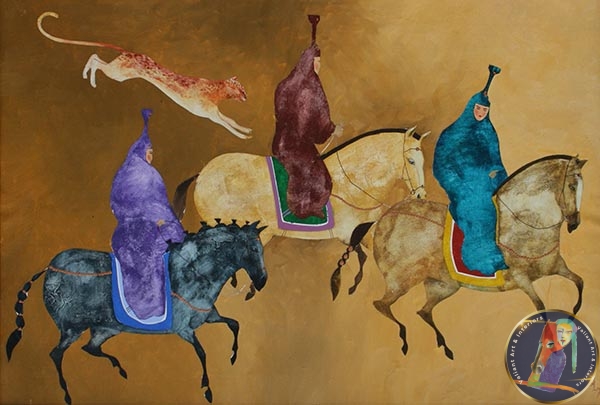
“Horse Composition 1” is a captivating oil-on-canvas painting that seamlessly blends traditional Mongolian iconography with a sleek, contemporary aesthetic. Set within a horizontal 40 x 60 cm frame, the artwork presents a stylized, poetic interpretation of Mongolia’s most revered animal—the horse.
Rather than a strictly photorealistic depiction, the composition leans into modern abstraction and fluid symbolism. The central focus features a small group of horses, their forms partially overlapping and merging, creating a powerful sense of unity, movement, and collective energy. The lines defining the horses are elegant and sweeping, capturing the essential grace, musculature, and spirit of the creatures with minimalist precision. The arrangement feels both ancient and remarkably modern, echoing the ancient petroglyphs of the steppes while utilizing a clean, sophisticated graphic sensibility.
Color Palette & Atmospheric Depth
The color palette is a sophisticated, deliberate harmony of earth tones and striking modern contrasts.
The Background: A textured, layered field of warm neutrals—ranging from soft cream and sandy beige to deep, resonant ochre and muted taupe. This atmospheric backdrop evokes the vastness of the Mongolian sky and the sweeping plains of the steppe, stripped down to its atmospheric essence.
The Subjects: The horses themselves are rendered in a blend of rich chestnut, deep umber, and charcoal tones, punctuated by sudden, brilliant highlights of stark white and subtle metallic undertones.
Texture & Light: The oil paint is applied with varied techniques; smooth, deliberate glazes give the horses a sleek, almost sculptural quality, while the surrounding background features subtle palette-knife textures and dry-brush stippling. This interplay of textures allows light to catch the canvas unevenly, suggesting the constant, shifting wind of the open plains.
Style & Cultural Essence
As a quintessential example of modern Mongolian contemporary art, the painting honors the deep-rooted nomadic connection to the horse while breaking free from traditional realism. Undram Enkhbold utilizes fluid, calligraphic brushstrokes that hint at traditional Mongolian script and line work, yet the flattening of perspective and the semi-abstracted, overlapping silhouettes firmly place the work in the realm of 21st-century modernism.
The overall mood is one of serene power and timeless motion. The horses do not feel anchored to a specific patch of dirt; instead, they seem to exist in a spiritual, eternal landscape. It is a quiet yet deeply moving celebration of heritage, stripped of clutter and distilled into pure form, color, and rhythm.
