
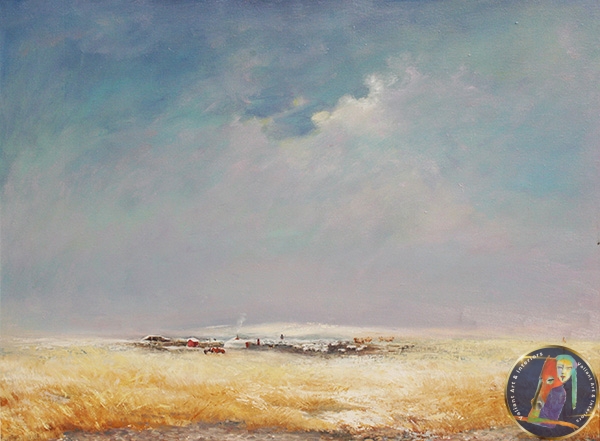
The painting is a wide, horizontally oriented landscape that captures the expansive, undulating plains of the Mongolian countryside. Adyabaatar utilizes a low horizon line, dedicating the bottom third of the canvas to the vast land and the upper two-thirds to a sweeping, open sky. This compositional balance creates an overwhelming sense of scale, isolation, and profound stillness. The viewer’s eye is guided smoothly from the immediate foreground across rolling hills that recede gently into the distant background.
Color Palette and Light
The color scheme is deeply tied to the natural tones of the Mongolian ecosystem. The land is rendered in a soft tapestry of earthy greens, muted ochres, and sun-bleached creams, reflecting the arid yet resilient vegetation of the Dund Gobi region. The light feels clean and diffused, mimicking the late afternoon sun when the shadows stretch long and thin across the terrain.
Above, the sky transitions from a soft, pale turquoise near the horizon to a deeper cerulean blue at the top of the canvas. Wispy, elongated stratus clouds are painted with delicate strokes of white and faint violet, hinting at the vast weather systems that pass over the open plains.
Texture and Detail
Executed in oil, the brushwork alternates between smooth, blended applications in the sky and more textured, visible strokes on the ground. The foreground features subtle, short brush marks that suggest the rough textures of wild steppe grasses and scrubby flora. In keeping with the artist’s focus on ecological realism and the quiet harmony between nature and living things, the vast landscape may feature tiny, meticulously detailed elements—such as a distant, solitary ger (traditional yurt) or a small, scattered herd of grazing livestock—which emphasize human and animal integration within the immense environment without disrupting its overall serenity.
Artistic Context: Created in 2008, Steppe is a quintessential example of Adyabaatar’s focus on “eco-art.” Rather than focusing on dramatic motion, the painting captures the “great peacefulness” of Mongolia, treating the land not merely as a background, but as a living, breathing subject defined by silence, space, and timelessness.