
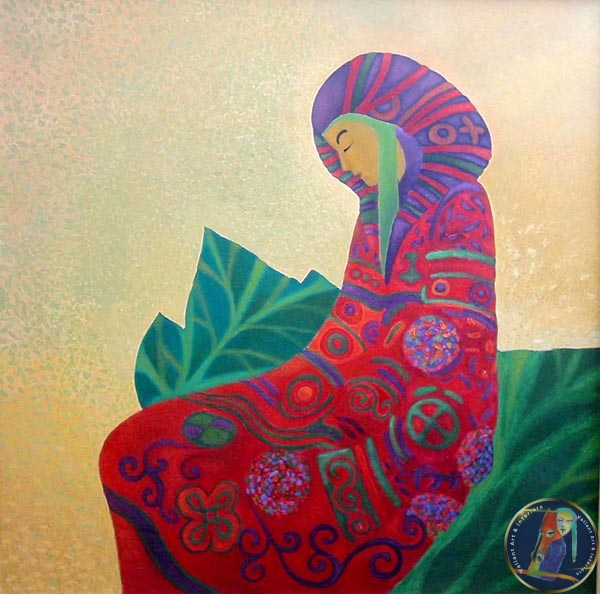
Waiting For Someone

Tuya Natsagdorj , 2004 , Oil On Canvas

Measuring precisely $100 \times 100\text{ cm}$, the painting utilizes a balanced, square format that grounds its emotional and thematic focus. The composition is built around a centralized or slightly off-center focal figure or symbolic subject that embodies the concept of “waiting.”

Tuya Natsagdorj’s background in scenography (stage and scene painting) from her time in Kyiv, Ukraine, heavily influences the spatial architecture of this piece. The canvas functions almost like a theater stage:

  • The Foreground: Houses the primary narrative subject—likely a lone figure, a stylized representation, or an evocative silhouette positioned to look outward or away from the viewer, directing attention toward an unseen horizon.

  • The Midground: Features atmospheric layering or minimalist geometric planes, a technique refined during her studies at the School of Art in Kyoto, Japan. This blending of structured depth with soft focus emphasizes a vast, lingering distance.

  • The Background: Tends toward a expansive, open sky or a semi-abstracted plain, evoking the endless, rolling landscapes of her native Mongolia. The horizon line is placed to heighten the feeling of isolation and anticipation.

2. Color Palette and Light

The color choices in Waiting For Someone strike a delicate balance between post-Soviet academic training and East Asian aesthetic sensibilities.

  • Dominant Hues: The canvas utilizes a thoughtful blend of deep, contemplative earth tones (ochres, deep ambers, and soft browns) alongside cooler, atmospheric grays or muted blues to establish a mood of quiet yearning.

  • Lighting and Atmosphere: Light within the painting does not stem from a harsh, direct source. Instead, it features a diffuse, ambient glow that seems to mimic the twilight hours—the traditional time of day associated with waiting and looking out into the distance. This soft illumination casts long, gentle shadows that emphasize the passing of time.

3. Brushwork and Technique

As an oil on canvas piece, Natsagdorj leverages the versatile texture of the medium to give the flat surface physical and emotional weight:

  • Textured Backgrounds: The landscape or background elements are rendered with broad, visible, and expressive brushstrokes or subtle palette knife work. This creates a tactile, slightly rugged surface reminiscent of traditional Mongolian oil paintings.

  • Delicate Focus: In contrast to the broader strokes of the environment, the main subject features smoother, more precise blending. This juxtaposition draws the eye directly to the center of the narrative.

  • Japanese Aesthetic Influence: There is a clear nod to Ma (the Japanese artistic concept of negative space or vacuums). Large sections of the canvas are intentionally left uncrowded, allowing the negative space to articulate the emotional weight of “emptiness” and the physical gap between the waiter and the person being waited for.

4. Thematic and Cultural Interpretation

The title, Waiting For Someone, acts as a bridge between nomadic Mongolian traditions and modern urban solitude. In traditional Mongolian culture, scanning the steppes for a rider, a loved one, or a traveler on the horizon is a deeply rooted daily reality. By abstracting this concept onto a square contemporary canvas, Natsagdorj elevates a specific cultural experience into a universal human emotion.

The painting captures a frozen sliver of time—not of action, but of pause. It leaves the narrative entirely open-ended, forcing the viewer to sit with the same quiet patience, uncertainty, and hope experienced by the subject within the frame.
  • Tuya Natsagdorj
  • Ulaanbaatar, Mongolia
  • Abstract, Expressionist, Figurative, Modern/Contemporary, Still Life
  • Oil on canvas
  • TUY49/019
  • 100 x 100cm39" x 39"
  • Valiant Art & Interiors

Add Your Comment

Mongolian Art Gallery © 2025. All Rights Reserved
Privacy Policy / Terms of Use

Measuring precisely $100 \times 100\text{ cm}$, the painting utilizes a balanced, square format that grounds its emotional and thematic focus. The composition is built around a centralized or slightly off-center focal figure or symbolic subject that embodies the concept of “waiting.”

Tuya Natsagdorj’s background in scenography (stage and scene painting) from her time in Kyiv, Ukraine, heavily influences the spatial architecture of this piece. The canvas functions almost like a theater stage:

  • The Foreground: Houses the primary narrative subject—likely a lone figure, a stylized representation, or an evocative silhouette positioned to look outward or away from the viewer, directing attention toward an unseen horizon.

  • The Midground: Features atmospheric layering or minimalist geometric planes, a technique refined during her studies at the School of Art in Kyoto, Japan. This blending of structured depth with soft focus emphasizes a vast, lingering distance.

  • The Background: Tends toward a expansive, open sky or a semi-abstracted plain, evoking the endless, rolling landscapes of her native Mongolia. The horizon line is placed to heighten the feeling of isolation and anticipation.

2. Color Palette and Light

The color choices in Waiting For Someone strike a delicate balance between post-Soviet academic training and East Asian aesthetic sensibilities.

  • Dominant Hues: The canvas utilizes a thoughtful blend of deep, contemplative earth tones (ochres, deep ambers, and soft browns) alongside cooler, atmospheric grays or muted blues to establish a mood of quiet yearning.

  • Lighting and Atmosphere: Light within the painting does not stem from a harsh, direct source. Instead, it features a diffuse, ambient glow that seems to mimic the twilight hours—the traditional time of day associated with waiting and looking out into the distance. This soft illumination casts long, gentle shadows that emphasize the passing of time.

3. Brushwork and Technique

As an oil on canvas piece, Natsagdorj leverages the versatile texture of the medium to give the flat surface physical and emotional weight:

  • Textured Backgrounds: The landscape or background elements are rendered with broad, visible, and expressive brushstrokes or subtle palette knife work. This creates a tactile, slightly rugged surface reminiscent of traditional Mongolian oil paintings.

  • Delicate Focus: In contrast to the broader strokes of the environment, the main subject features smoother, more precise blending. This juxtaposition draws the eye directly to the center of the narrative.

  • Japanese Aesthetic Influence: There is a clear nod to Ma (the Japanese artistic concept of negative space or vacuums). Large sections of the canvas are intentionally left uncrowded, allowing the negative space to articulate the emotional weight of “emptiness” and the physical gap between the waiter and the person being waited for.

4. Thematic and Cultural Interpretation

The title, Waiting For Someone, acts as a bridge between nomadic Mongolian traditions and modern urban solitude. In traditional Mongolian culture, scanning the steppes for a rider, a loved one, or a traveler on the horizon is a deeply rooted daily reality. By abstracting this concept onto a square contemporary canvas, Natsagdorj elevates a specific cultural experience into a universal human emotion.

The painting captures a frozen sliver of time—not of action, but of pause. It leaves the narrative entirely open-ended, forcing the viewer to sit with the same quiet patience, uncertainty, and hope experienced by the subject within the frame.