
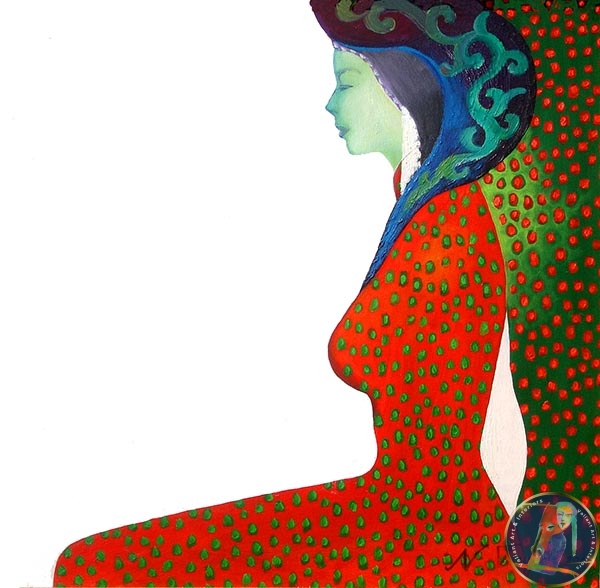
Waiting

Tuya Natsagdorj , 2006 , Oil On Canvas

The painting is framed within a strict 60 x 60 cm square canvas. In visual art, a perfect square denies the viewer the natural horizontal sweep of a landscape or the verticality of a traditional portrait. Instead, it forces a concentrated, high-focus centering.

The title, Waiting, suggests a narrative suspended in time. Given Natsagdorj’s early training in scenic stage painting in Kyiv, Ukraine, the composition likely treats the canvas like a theatrical proscenium. The subject—whether a human figure, an symbolic object, or an expansive Mongolian horizon paired with an interior—is framed with dramatic intent. The space feels deliberate, where the negative space (the empty areas around the subject) carries as much emotional weight and tension as the subject itself.

Color Palette and Light

Natsagdorj’s palette is an intricate cross-pollination of her environments:

  • The Mongolian Bedrock: Expect deep, earth-toned undercurrents—ochres, burnt sienna, and the expansive, brilliant blues of the Mongolian sky—reflecting her roots in Ulaanbaatar.

  • The Slavic Dramatic Contrast: Her time in Ukraine often translates into a bold, expressive use of light and shadow (chiaroscuro) to heighten the emotional stakes of “waiting.”

  • The Japanese Atmospheric Veil: Her studies in Kyoto introduce a subtle appreciation for ma (negative space) and soft, low-saturation color washes.

The light within the painting doesn’t just illuminate; it narrates. It is likely directional, catching the edge of a figure or a windowsill, leaving the rest of the canvas in a state of soft, contemplative dimness that mirrors the internal psychological state of waiting.

Texture and Medium Application

Executed in oil on canvas, the medium allows for rich, layered storytelling. Natsagdorj’s brushwork balances the heavy, tactile presence of oil paint with smooth, atmospheric transitions.

  • Certain areas of the canvas may feature impasto (thickly applied paint), giving a rugged, weathered texture to traditional clothing, hair, or structural elements.

  • In contrast, the background elements are likely blended smoothly, creating a dreamlike, hazy depth that makes the central theme of passage of time feel palpable.

Thematic and Cultural Symbolism

As a prominent voice in modern Mongolian women’s art (highlighted by her inclusion in the 1993 Mongolian Women’s Exhibition), Waiting safely bypasses generic tropes to look at the quiet, often unseen strength of its subject.

If the painting features a female figure, she is likely depicted not in active grief or longing, but in a state of grounded, meditative patience. The clothing or surrounding motifs subtly bridge nomadic Mongolian traditions with a stark, clean modernism. Every element inside the square frame serves to compress time, capturing that singular, heavy breath right before something changes.

  • Tuya Natsagdorj
  • Ulaanbaatar, Mongolia
  • Abstract, Expressionist, Figurative, Modern/Contemporary, Still Life
  • Oil on canvas
  • TUY49/014
  • 60 x 60cm23" x 23"
  • Valiant Art & Interiors

Add Your Comment

Mongolian Art Gallery © 2025. All Rights Reserved
Privacy Policy / Terms of Use

The painting is framed within a strict 60 x 60 cm square canvas. In visual art, a perfect square denies the viewer the natural horizontal sweep of a landscape or the verticality of a traditional portrait. Instead, it forces a concentrated, high-focus centering.

The title, Waiting, suggests a narrative suspended in time. Given Natsagdorj’s early training in scenic stage painting in Kyiv, Ukraine, the composition likely treats the canvas like a theatrical proscenium. The subject—whether a human figure, an symbolic object, or an expansive Mongolian horizon paired with an interior—is framed with dramatic intent. The space feels deliberate, where the negative space (the empty areas around the subject) carries as much emotional weight and tension as the subject itself.

Color Palette and Light

Natsagdorj’s palette is an intricate cross-pollination of her environments:

  • The Mongolian Bedrock: Expect deep, earth-toned undercurrents—ochres, burnt sienna, and the expansive, brilliant blues of the Mongolian sky—reflecting her roots in Ulaanbaatar.

  • The Slavic Dramatic Contrast: Her time in Ukraine often translates into a bold, expressive use of light and shadow (chiaroscuro) to heighten the emotional stakes of “waiting.”

  • The Japanese Atmospheric Veil: Her studies in Kyoto introduce a subtle appreciation for ma (negative space) and soft, low-saturation color washes.

The light within the painting doesn’t just illuminate; it narrates. It is likely directional, catching the edge of a figure or a windowsill, leaving the rest of the canvas in a state of soft, contemplative dimness that mirrors the internal psychological state of waiting.

Texture and Medium Application

Executed in oil on canvas, the medium allows for rich, layered storytelling. Natsagdorj’s brushwork balances the heavy, tactile presence of oil paint with smooth, atmospheric transitions.

  • Certain areas of the canvas may feature impasto (thickly applied paint), giving a rugged, weathered texture to traditional clothing, hair, or structural elements.

  • In contrast, the background elements are likely blended smoothly, creating a dreamlike, hazy depth that makes the central theme of passage of time feel palpable.

Thematic and Cultural Symbolism

As a prominent voice in modern Mongolian women’s art (highlighted by her inclusion in the 1993 Mongolian Women’s Exhibition), Waiting safely bypasses generic tropes to look at the quiet, often unseen strength of its subject.

If the painting features a female figure, she is likely depicted not in active grief or longing, but in a state of grounded, meditative patience. The clothing or surrounding motifs subtly bridge nomadic Mongolian traditions with a stark, clean modernism. Every element inside the square frame serves to compress time, capturing that singular, heavy breath right before something changes.