
1. Subject Matter and Composition
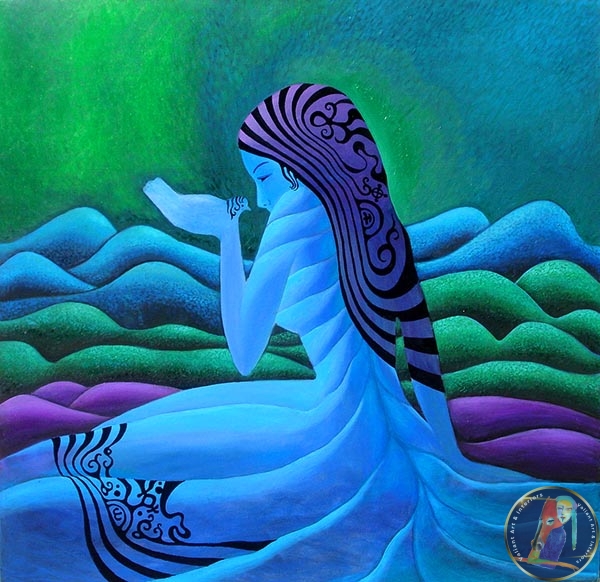
“Shivnee”—a Mongolian term translating directly to “The Whisper” or “Whispering”—is rendered on a perfectly square $80 \times 80\text{ cm}$ canvas. The painting utilizes Natsagdorj’s hallmark thematic focus: the evocative, symbolic portrayal of the female form. True to her training in theatrical scene painting in Kyiv and fine arts in both Ulaanbaatar and Kyoto, the composition balances dramatic, staged placement with East Asian compositional clarity.
The center of the composition features stylized, elegant female figures positioned close together, conveying an intimate, secretive narrative. The spatial arrangement focuses tightly on the body language, hand gestures, and tilted head positions of the figures, mimicking the physical act of sharing a quiet, profound secret or ancient folklore.
2. Palette and Color Theory
The painting is dominated by an evocative, atmospheric palette where international modernism meets traditional Mongolian symbolism:
The Dominant Blues: Deep indigos, rich teals, and soft cerulean tones envelope the canvas. In modern Mongolian figurative art, these cool tones bridge the physical world with the spiritual, echoing the timelessness of the “Eternal Blue Sky” (Munkh Khukh Tenger).
Warm Contrast Highlights: Soft skin tones, muted ochres, or subtle coral undertones emerge through the shadows, creating a gentle chiaroscuro effect. This contrast emphasizes the warmth and vulnerability of the figures amidst a stylized, cool background.
3. Brushwork and Texture
The oil medium is applied with deliberate, expressive layers that showcase Natsagdorj’s versatile education:
Smooth, blending brushwork models the soft anatomy of the stylized female silhouettes, giving them a statuesque, goddess-like elegance.
Touches of texture are visible in the background or within clothing drapery, drawing subtle inspiration from Japanese textile sensibilities and European expressionist layering.
4. Symbolism and Cultural Context
Rather than pursuing strict realism, Natsagdorj leans heavily into ornamental symbolism. The figures operate as timeless archetypes of Mongolian womanhood, intimacy, and the safe spaces shared between women. The “whisper” represents oral tradition, ancestral memory, and the unseen bond connecting generations. The square canvas creates a sense of equilibrium, trapping the viewer inside this quiet, private moment where time feels suspended.