Flowers

Tuya Natsagdorj , 2005 , Oil On Canvas

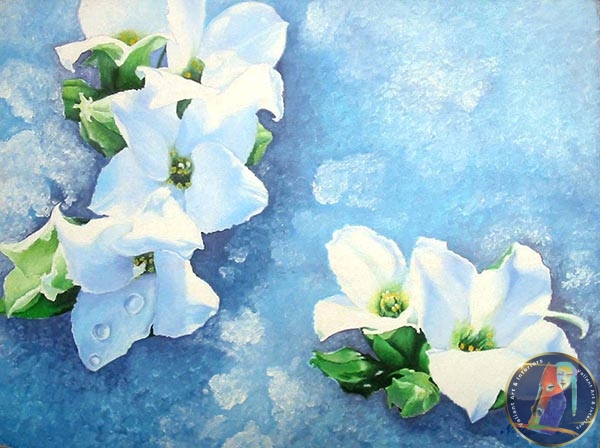
Flowers is an intimate, expressive still-life oil painting by Mongolian contemporary artist Tuya Natsagdorj. Measuring 30 by 40 centimeters, the composition features a vibrant arrangement of botanical forms rendered on a stretched canvas. The artwork balances the bold, gestural brushwork characteristic of late 20th-century contemporary Mongolian art with subtle stylistic influences drawn from the artist’s international background in scene painting and East Asian aesthetics.

Subject Matter and Composition

The central focus of the canvas is a dynamic cluster of flora, captured in a moment of full bloom. Rather than a rigid, classical arrangement, the flowers possess a fluid, organic energy, with petals and stems overlapping to create a sense of depth and movement. The composition is tightly cropped, drawing the viewer’s eye immediately into the textures and shifting tones of the blossoms. The arrangement occupies the majority of the pictorial space, interacting dramatically with the atmospheric, abstracted background.

Color Palette and Light

The color scheme is rich and evocative, utilizing a sophisticated interplay of contrasting temperatures.

  • The Flora: The blossoms are brought to life through layered hues of vivid reds, soft pinks, and deep ochres, punctuated by shots of crisp whites or pale creams to suggest where light catches the delicate surfaces of the petals.

  • The Foliage: Deep emerald greens, olives, and muted teals form the structural undercurrent of the bouquet, providing a grounding contrast to the warmer floral tones.

  • The Background: The negative space is treated with an atmospheric blend of neutral tones—varying shades of amber, muted grays, or deep earth tones—which makes the central subject visually pop forward.

The lighting within the piece is subjective and diffused, eschewing harsh, directional spotlights in favor of an inner radiance that emanates from the rich impasto layers of the paint itself.

Technique and Materiality

Natsagdorj’s technique highlights the physical properties of the oil medium. The paint is applied with confident, visible brushstrokes that range from thin, fluid glazes to thick, textured impasto applications. This textural variety gives the petals a tangible, sculptural quality. The artist’s background in theatrical scene painting is evident in the confident scale of the marks and the dramatic, expressive weight of the forms, while a certain minimalist restraint hints at a cross-cultural synthesis of form.

Condition and Presentation

The painting is executed on a fine-weave canvas, tightly wrapped and secured. The surface texture remains vibrant, with the varying thicknesses of the oil paint creating a subtle play of light across the matte and semi-gloss areas of the composition. It stands as a compelling example of modern Mongolian still-life painting, blending classical observation with expressive freedom.
  • Tuya Natsagdorj
  • Ulaanbaatar, Mongolia
  • Abstract, Expressionist, Figurative, Modern/Contemporary, Still Life
  • Oil on canvas
  • TUY49/003
  • 30 x 40cm12" x 16"
  • Valiant Art & Interiors

Add Your Comment

Mongolian Art Gallery © 2025. All Rights Reserved
Privacy Policy / Terms of Use

Flowers is an intimate, expressive still-life oil painting by Mongolian contemporary artist Tuya Natsagdorj. Measuring 30 by 40 centimeters, the composition features a vibrant arrangement of botanical forms rendered on a stretched canvas. The artwork balances the bold, gestural brushwork characteristic of late 20th-century contemporary Mongolian art with subtle stylistic influences drawn from the artist’s international background in scene painting and East Asian aesthetics.

Subject Matter and Composition

The central focus of the canvas is a dynamic cluster of flora, captured in a moment of full bloom. Rather than a rigid, classical arrangement, the flowers possess a fluid, organic energy, with petals and stems overlapping to create a sense of depth and movement. The composition is tightly cropped, drawing the viewer’s eye immediately into the textures and shifting tones of the blossoms. The arrangement occupies the majority of the pictorial space, interacting dramatically with the atmospheric, abstracted background.

Color Palette and Light

The color scheme is rich and evocative, utilizing a sophisticated interplay of contrasting temperatures.

  • The Flora: The blossoms are brought to life through layered hues of vivid reds, soft pinks, and deep ochres, punctuated by shots of crisp whites or pale creams to suggest where light catches the delicate surfaces of the petals.

  • The Foliage: Deep emerald greens, olives, and muted teals form the structural undercurrent of the bouquet, providing a grounding contrast to the warmer floral tones.

  • The Background: The negative space is treated with an atmospheric blend of neutral tones—varying shades of amber, muted grays, or deep earth tones—which makes the central subject visually pop forward.

The lighting within the piece is subjective and diffused, eschewing harsh, directional spotlights in favor of an inner radiance that emanates from the rich impasto layers of the paint itself.

Technique and Materiality

Natsagdorj’s technique highlights the physical properties of the oil medium. The paint is applied with confident, visible brushstrokes that range from thin, fluid glazes to thick, textured impasto applications. This textural variety gives the petals a tangible, sculptural quality. The artist’s background in theatrical scene painting is evident in the confident scale of the marks and the dramatic, expressive weight of the forms, while a certain minimalist restraint hints at a cross-cultural synthesis of form.

Condition and Presentation

The painting is executed on a fine-weave canvas, tightly wrapped and secured. The surface texture remains vibrant, with the varying thicknesses of the oil paint creating a subtle play of light across the matte and semi-gloss areas of the composition. It stands as a compelling example of modern Mongolian still-life painting, blending classical observation with expressive freedom.