
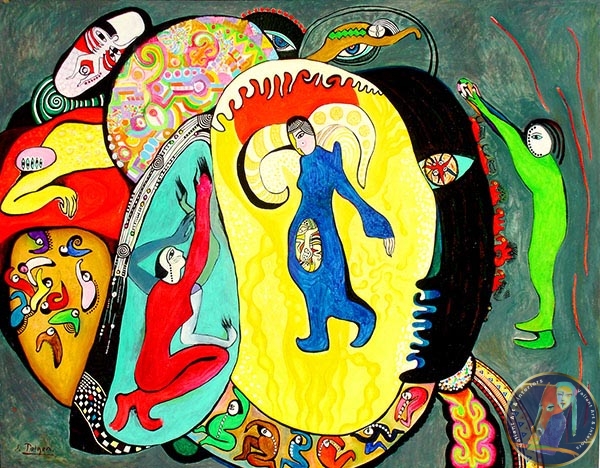
“Noise” is a compelling oil on canvas painting by Mongolian-born Kazakh artist Tolgan Janatkhan (b. 1977). Measuring 112 x 146 cm, this large-scale contemporary work operates at the intersection of abstract expressionism and cultural symbolism. True to its title, the painting visually translates the sensory, auditory concept of “noise” into a rich tapestry of color, movement, and textured form.
Composition and Style
The composition is dense and dynamic, capturing the chaotic yet harmonious essence of sound. Janatkhan utilizes bold, gestural brushstrokes and layered palette-knife techniques to create a vibrating surface texture. Rather than a chaotic mess, the “noise” is structured with an innate rhythmic balance—a testament to the artist’s upbringing in an environment deeply rooted in music and craftsmanship.
Color Palette
The color palette is both vibrant and evocative, leaning on the artist’s philosophy of finding ultimate happiness and life expression through color.
Dominant Tones: Intense, saturated hues of deep crimson, electric blues, and fractured yellows dominate the canvas, suggesting a high-energy environment filled with ambient sound.
Contrast and Depth: Earthy tones of ochre, charcoal gray, and raw umber undercut the bright colors, providing a grounded, organic contrast that hints at the vast Mongolian landscapes and traditional Kazakh aesthetics.
Light and Motion: Shards of white and pale cream cut through the darker passages, acting as visual “crescendos” or sharp, sudden sounds breaking through a background drone.
Themes and Interpretation
While abstract, “Noise” carries a profound emotional weight. Created during a pivotal era in the artist’s early career (around the time of his landmark “OT” exhibition and international showcases in the late 1990s and 2000), the piece reflects the transition from childhood wonder to mature artistic initiation (recollecting his name Tolgau, meaning “initiate”).
The canvas does not depict literal noise, but rather the psychological and spiritual “noise” of life, memory, and creative impulse. It captures the bustling internal dialogue of an artist who grew up in a “fantastic universe of color and music,” translating sensory memory into a permanent visual record.