

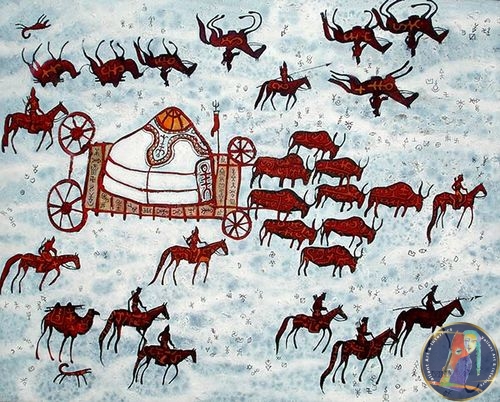
Jingiin Tsuvaa 2 (Caravan 2) is a compelling synthesis of Mongolian heritage and Contemporary Expressionism. Created during a period of high international visibility for Tserennadmid, the painting captures the rhythmic, timeless movement of a caravan across the vast Mongolian landscape. Rather than a literal representation, the artist employs an abstracted, modern lens to evoke the spirit of nomadic life.
Composition and Style
The work is characterized by the bold, energetic brushwork typical of Tserennadmid’s style. It strikes a balance between formal structure and fluid emotion:
Rhythmic Movement: The “Tsuvaa” (caravan) is depicted as a series of repeating forms that stretch across the canvas. This creates a sense of perpetual motion, mirroring the nomadic heartbeat of Central Asia.
Color Palette: Utilizing the rich textures of oil, the artist likely employs a palette that reflects the earthy tones of the steppe—ochres, deep browns, and burnt oranges—contrasted with the ethereal blues or grays of the Mongolian sky.
Expressionist Technique: Instead of fine detail, the artist uses heavy impasto and sweeping strokes to define the shapes of camels and travelers. This shifts the focus from the “who” to the “feeling” of the journey, emphasizing the endurance and isolation of the desert trek.
Artistic Context
As a former President of the University of Art & Culture in Ulaanbaatar, Tserennadmid’s work serves as a bridge between traditional Mongolian themes and global Modernist trends.
In Jingiin Tsuvaa 2, the “landscape” is not merely a background but an active participant. The 72.5 x 90.5 cm scale provides a cinematic window into a world where the horizon is infinite. The painting reflects the same cultural prestige that led to its contemporary works being exhibited in major art hubs like London, Montreal, and Las Vegas shortly after its completion.
