Edelweiss

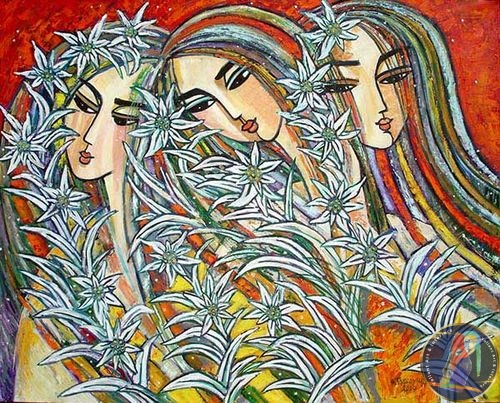
Tugs-oyun Sodnom , 2006 , Oil On Canvas

Edelweiss is a compelling oil-on-canvas work that serves as a bridge between Tugs-oyun Sodnom’s rigorous academic training in Moscow and the evocative, nomadic spirit of his Mongolian heritage. Measuring 80 x 100 cm, the piece utilizes its horizontal orientation to create a sense of expansive, atmospheric depth.


Visual Composition and Style

The painting is a masterclass in Contemporary Figurative Abstraction. While the title suggests a botanical subject, Sodnom eschews a scientific or literal representation of the mountain flower. Instead, he captures the essence of the Edelweiss—a symbol of purity and resilience in the harsh Mongolian highlands.

  • The Palette: The work is dominated by a sophisticated interplay of muted cools and earthy warmth. Expect to see “broken” whites, silvers, and misty greys that mimic the fuzzy texture of the flower’s petals, set against deep ochres, burnt umbers, and slate blues that ground the composition.

  • Brushwork: Reflecting his education at the Surikov Institute, Sodnom employs a confident, painterly technique. The paint is likely applied in layers (impasto), with visible palette knife strokes or dry-brushing that creates a tactile, weathered surface reminiscent of the rugged Siberian and Mongolian terrain.

Thematic Depth

Sodnom’s background as a prolific book designer influences the graphic integrity of the piece. There is a rhythmic balance between the “negative space” of the canvas and the “positive” forms of the flora.

  • Modernity vs. Tradition: The 2006 creation date places this in Sodnom’s mature period. It reflects a shift away from the strict Socialist Realism of his early Soviet training toward a more personal, Modernist expression. The Edelweiss becomes a metaphor for Mongolian identity—delicate in appearance but enduring through extreme shifts in climate and culture.

  • Atmosphere: The painting likely feels “airy” yet dense. The 80 x 100 cm scale is large enough to immerse the viewer in a dreamlike field where the flowers seem to emerge from a fog, blurring the lines between a landscape study and a pure abstract emotional expression.
  • Tugs-oyun Sodnom
  • Abstract, Figurative
  • Oil On Canvas
  • TUO68/001
  • 80 x 100cm
  • Mongolian Art Gallery

Add Your Comment

Mongolian Art Gallery © 2025. All Rights Reserved
Privacy Policy / Terms of Use

Edelweiss is a compelling oil-on-canvas work that serves as a bridge between Tugs-oyun Sodnom’s rigorous academic training in Moscow and the evocative, nomadic spirit of his Mongolian heritage. Measuring 80 x 100 cm, the piece utilizes its horizontal orientation to create a sense of expansive, atmospheric depth.


Visual Composition and Style

The painting is a masterclass in Contemporary Figurative Abstraction. While the title suggests a botanical subject, Sodnom eschews a scientific or literal representation of the mountain flower. Instead, he captures the essence of the Edelweiss—a symbol of purity and resilience in the harsh Mongolian highlands.

  • The Palette: The work is dominated by a sophisticated interplay of muted cools and earthy warmth. Expect to see “broken” whites, silvers, and misty greys that mimic the fuzzy texture of the flower’s petals, set against deep ochres, burnt umbers, and slate blues that ground the composition.

  • Brushwork: Reflecting his education at the Surikov Institute, Sodnom employs a confident, painterly technique. The paint is likely applied in layers (impasto), with visible palette knife strokes or dry-brushing that creates a tactile, weathered surface reminiscent of the rugged Siberian and Mongolian terrain.

Thematic Depth

Sodnom’s background as a prolific book designer influences the graphic integrity of the piece. There is a rhythmic balance between the “negative space” of the canvas and the “positive” forms of the flora.

  • Modernity vs. Tradition: The 2006 creation date places this in Sodnom’s mature period. It reflects a shift away from the strict Socialist Realism of his early Soviet training toward a more personal, Modernist expression. The Edelweiss becomes a metaphor for Mongolian identity—delicate in appearance but enduring through extreme shifts in climate and culture.

  • Atmosphere: The painting likely feels “airy” yet dense. The 80 x 100 cm scale is large enough to immerse the viewer in a dreamlike field where the flowers seem to emerge from a fog, blurring the lines between a landscape study and a pure abstract emotional expression.